Pages

Thursday, 30 June 2016

Book Review: The Fire that Never Sleeps - Keys to Sustaining Personal Revival by John Kilpatrick & Michael L Brown

Reviewed by Ian Acheson

Photo courtesy of Destiny Image
Blurb

Get Revived . . . and Stay On Fire!

 “I had such a powerful experience with God. He touched my heart so deeply… and after that one encounter, I wanted to live for Jesus every day for the rest of my life.

Then life went back to normal.

Sound familiar?

Perhaps you’ve had an encounter with God that powerfully impacted your life – where sin, addiction, spiritual dryness or other struggles simply faded away. If such experiences are commonplace when revival is happening, then . . .

How can I experience revival every single day of my life?

With guidance from the leaders of the Brownsville Revival and the Bay of the Holy Spirit Revival, you will ignite and sustain your passion for Jesus and learn how:
  • Desperate prayer unleashes the supernatural power of God into your life
  • Repentance is your key to enjoying unbroken intimacy with the Holy Spirit
  • You can become a catalyst for great awakening in your church, city, and nation

 Get ready to live passionately for Jesus, walk out God’s divine purpose for your life, and enjoy His presence on a daily basis.

It’s time to revive your fire!

My Review

This outstanding book provides both the background to the Brownsville revival that started in 1995 and an outline to how every believer can be experiencing revival in their personal lives. Michael Brown is a scholar of revival and John Kilpatrick was one of the pastors intimately involved in Brownsville. They know what they're talking about having both experienced revival first hand but studied the history of revival throughout the last two hundred or so years incorporating insights from such people as Charles Wesley, Charles Finney, William Booth, George Whitfield, Leonard Ravenhill, A. W. Tozer, and D. L. Moody.

The books starts with an sobering perspective of the modern church. "The world is actually evangelising the church." was a line that struck me as being true where we've allowed the culture of the time to play too prominent a role in the church. This can discourage us or we can look upon it with much hope. Jesus loves the church and will not let it fall. The potential for revival is enormous.

Kilpatrick then describes how he started praying for revival and then takes us into the days (and years) of when the Presence of the Lord was thick upon his congregation. Here was a man who consecrated his life to Jesus and desired for the Lord to be glorified not just in his church but in the years beyond. As the authors repeatedly state, the true measure of revival isn't about the manifestations of the Spirit but the ongoing transformation of the people years after the events.

They may define revival as a "season of unusual Divine visitation" however, in this book they stress that revival should be the norm for Christians. We should all be living like the first church did in Acts. Accordingly, the world would be transformed by the glory of God.

I couldn't put this book down. It has birthed a desire for more, just like David in Psalm 27. More of His Presence, more of Jesus in my life. With practical strategies on how to recharge and maintain a heart on fire for Jesus, this book is a little gem and has re-energised my desire for more of the Lord in my prayer life.

"Revival and revolution go hand in hand. When the church is truly revived, it will have a revolutionary impact on the culture."

Amen.

Wednesday, 29 June 2016

Stories that Save the World


Yesterday, I was the invited guest at a book launch. I had worked as the editor on a 20th anniversary memoir project for the Rocky River Garden Club. My auntie, who is a long term member of the club, suggested a book be written about their adventures of the last 20 years, and asked my mother to help her. Given my mother’s help on other local folk-history projects, she agreed, and they spent 10 months combing through the minutes of the garden club meetings, trying to find something of interest to write about. They were minutes, and didn’t make riveting reading.
My mother soon saw the dilemma – no character, no action, no plot – just the happenings of a group of garden enthusiasts. It was then that she proposed they attack the project from another angle—finding the story behind the minutes. It wasn’t long and the two committee members and my mother were meeting once a week, and through careful questioning and prodding, stories began to emerge. Some were interesting stories, some were lol amusing, and some were just a record of things that had been a part of this folk history.

When I spoke to the group at the launch, I told them about story. I talked about the oral culture of the ancient civilisations and the persisting story culture of some people groups like our Indigenous Australians. I mentioned the value of story in historical research, how an interview with a person who has lived through a time period or event, can be used and cited as primary evidence in an academic paper. I used such an interview with an elderly woman when I was doing research for a History assignment. The interview I conducted consisted of me sitting down with her as she told me stories of a time gone by, and a family long since passed away. 

Story and story-telling is a valuable part of keeping culture and history alive. My grandmother was a grand story teller. I would sit for hours and listen to her accounts of life during the depression era, or during the war. In the year she died, my mother had the presence of mind to press record on a cassette recorder as my grandmother sat with her younger sister and they got to talking about their adventure as pioneers on the West Coast of South Australia around 1910. They were young girls of 11 and 9, travelling on a bullock wagon, chickens in cages beneath, the milk cow tied behind, part of a convoy of wagons travelling across unsettled land to a place where no white man had settled before. My mother transcribed that time of storytelling, and I have it on my computer. I’m going to include a small portion of it for you to read, and hope you can see how valuable story-telling is in the passing down of family and folk history.

“...We took off the next day travelled on, one day merging into the next, we passed through, Yardea, Thurlga, Nonning, Pandoora, and other station properties. When we got to Yardea, our baby brother Keith was very sick and so we stayed there a day or two while the post master rang Adelaide to get the Doctor's advice. We were leading a house cow behind the bullock wagon and the word came back that as Keith was being fed on cow’s milk, and the cow was having different food every day, it was upsetting the baby. So the Doctor said “Take him off the cow’s milk and put him onto some other product". Well he began to improve and so we went on again.
We came to Lake Gillies and I remember you could see the reflection of wild dogs in the water as they ran along the banks, and you could hear them howling in the night. As we passed on, one day was much the same as the other except that sometimes we would have to go on to about 10 o’clock at night before we reached water because you couldn’t bed down for the night without having water for your stock.
In some parts, the men would have to get down into these places that were like soaks and dip the water out with something like a jam tin to water sixteen bullocks and twenty  horses, it would take hours. It was a real business it was one of the biggest problems.
In those days on the West Coast, water was very very scarce, water was like gold in fact water would save your life but gold wouldn’t. Washing for the baby was so difficult, poor old mother had many a struggle to get enough water to wash the babies naps, and some of the water holes we got to, old dams, they’d have dead beasts or sheep all over them and we had to drink that because we had no other water, but it had to be boiled, all boiled before it could be used. Every night at camp everyone would do their own cooking. Mother used to make what she called scone bread, baking powder bread, cooked in the camp oven with coals on the top and underneath and believe me it was lovely, we enjoyed every bit of it.
I don’t think anything tasted as good to me as that bread with boiled potatoes and onions, oh you’d have an appetite like a horse and it tasted so nice. One night we had to peel the onions and we peeled a stew pan full of them so everyone had onions that night. Gee they were nice...”

Taken from an interview with Ella Bishop, 1985.

I used this practice of storytelling in 2003 when I was asked to write a book for my home town’s 150th celebration. A proper history book had already been written some twenty years earlier, so I hit upon the idea of writing a folk history novel. I invented a fictional character, and told a story from his point of view. To put the book together, my mother and I conducted many interviews with long-time residents of the town. We put questions to them about fire, flood, plague, drought, football, the CWA, the school; anything that was common to them all. The yarns that flowed during these interviews were priceless. I then sorted through the yarns, and wove them into my overall story. In response, I’ve had many people tell me they laughed out loud at some of the goings on in the story. Usually the funniest parts of the story were true.
I still sell this story in the town, and have recently made it available as an eBook and it can be ordered from Fishpond.com as a paperback. Of all the books I have written, this one was the emotional story I had to write. It was the story of us, if you like—the story of those people who call themselves Melrose locals. But it is not just for the folks of this small country town, it relates to all people who’ve lived in a country town or village.
I feel satisfied that I have been privileged to construct a story that reflects the folk history of my hometown. It is unlikely to become a bestseller, but I know I’ve done my part to help preserve the small country-town life of the 20th Century for future generations.


Meredith Resce is a novelist who has 17 published titles, plus two eBook short stories.

You can read more about her on her website: www.meredithresce.com

One Remarkable Year is the folk-history novel of the town of Melrose, South Australia

Tuesday, 28 June 2016

Why Are Social Networks Important?

Of making many books there is no end, 
and much study wearies the body 
(Ecc 12:12 NIV)

Yes, much study wearies the body (and the mind).

The same could be said of social networks and social media—there is no end to them, and just the thought is enough to make our eyes glaze over and our minds grow dim (or is that just me?)

Yesterday I gave a whistle-stop tour of 13 social popular networks which may or may not of relevance to us as authors. But wait! There's more! (I'm starting to sound like an infomercial.)

ClassMates

Reconnecting with old classmates and workmates. FriendsReunited is a UK-based alternative.

Flickr

Yahoo's photo sharing platform, which is older than Instagram and Pinterest, but has now been overshadowed by them.

Medium

Similar to Tumblr, and described by About.com as "perhaps the best social network for readers and writers". Perhaps this is one to check out.

Meetup

Organising local groups around specific interests.

Periscope

A Twitter-owned app offering live video broadcasting from your mobile device. It's gaining popularity among non-fiction writers, perhaps as a more current form of podcasting. Blab is a similar tool.

Reddit

A curation tool, where communities come together to discuss topics in subreddit threads. If I knew what any of those words meant, I’d tell you. I suspect Reddit is most useful for non-fiction writers – but it’s a curation tool, which probably means it’s something I should check out.

Tinder

A dating app. Your fictional characters might use it.

Vine

Short videos that can be embedded in Tweets (as Vine is owned by Twitter)

But . . . Why are Social Networks Important?


As I see it, there are two main functions of social networking for authors:
  • To help us connect with readers
  • To help us connect with other writers
This is why social networks are important. Writers often work in isolation, and online social networks provide us with valuable and necessary ways to connect with others. My favourite social network is Facebook, and I think of it as the kitchen or water cooler in my virtual office, the place I head for a short break to recharge before starting the next item on my to-do list.

Connecting with Readers

I believe connecting with readers is more important to an author's long-term success, because it is the readers who are going to buy your book (or books). For this reason, my suggestions around social networks are more focused on connecting with readers than with other writers--as this is the weak spot for most writers.

We need readers.

We need readers because they read our books. They talk about our books. They review our books. They buy our books. Sure, writers are also readers (or should be). But there are more readers than writers.

Connecting with Writers

Yes, connecting with writers is important, especially in the early stages of your writing. You need to learn to write, and other writers are going to be the people who help with that. Writers will be your first teachers, your first readers, your first fans. They will give you advice on what do, and what not to do. They will help you find a community, essential if your writing is ever going to be anything more than you and a computer.

But in the long term, connecting with readers is more important. Because while all writers are readers (or should be), not all readers are writers.

So what do you want or need from a social networking site:
  • The ability to connect with other users
  • A market demographic that matches your target reader

This means the social networks which are right for me might not be the same as those which are right for you. For example, I discovered as I was researching this post that there are specific social networks for specific groups (this probably shouldn't have surprised me, but it did).

For example, MyMFB has 1.5+ billion followers, and is touted as the Muslim alternative to Facebook. Twoo is a Belgian site geared to teenagers and twenty-somethings, while Renren (everyone's website) is China's largest social platform. VK.com is the Russian version. None of these are appropriate websites for me, as my target reader is a Christian with English as their first language.

But these social networks could be great options for writers targeting non-Christian readers in these countries and people groups.

So, no, you don't need to be on every social network. But you probably do need to be active on a couple of social networks. And you do need your own author website (discussed in this post), and you almost certainly need an email list (click here if you'd like to join mine!).

This is the conclusion in our series of posts on social networking (well, almost. Narelle has an upcoming post about Google+). Have we answered your questions about social media and social networking for authors? What more would you like to know? And what important information have we missed in this whistle-stop tour? Le us know in the comments!

About Iola Goulton

I am a freelance editor specialising in Christian fiction, and you can find out more about my services at my website (www.christianediting.co.nz), or follow me on Facebook (https://www.facebook.com/christianediting), Twitter (@IolaGoulton) or Pinterest (http://pinterest.com/iolasreads).

Monday, 27 June 2016

13 Popular Social Networks for Authors

Over the last couple of months, ACW has looked at various social networks writers use to connect with readers (and other writers). Yes, this is starting to feel like the neverending story . . .


We've already looked at:

  1. Twitter
  2. Facebook (post 1 and post 2)
  3. Pinterest
  4. Instagram
  5. Goodreads (post 1 and post 2)
  6. Klout (Simon Kennedy and I had the same view) 
  7. Tsu (and I think we're all agreed it's not the new Facebook). 
  8. One major social network we haven’t yet covered is Google+, and Narelle will be looking at that next month.


This week I'm going to take a whistle-stop tour through some of the other popular social networks--and my views on which sites you can safely ignore, and which you might need to investigate.

Popular Social Networks


9. LinkedIn

LinkedIn is a social network with a difference: it's geared towards business. EbizMBA.com report LinkedIn as the fourth most popular social networking site for June 2016, with an Alexa ranking of 9.

Should authors use LinkedIn? They should probably have an account, but the focus on professional connections means LinkedIn isn't going to be a place to connect with fiction readers. Sure, LinkedIn members will read fiction, but they won't be using LinkedIn to search for the next novel to read.

However, being active on LinkedIn might be part of an overall marketing or social media strategy for non-fiction authors, especially consultants who have written a book as a way of promoting their expertise in a specific area.

10. Snapchat

Snapchat is a video platform popular with teenagers. The attraction is that you can send a short video message which theoretically self-destructs as soon as it has been read (how Mission Impossible!). I say "theoretically" because I've read that Snapchat doesn't actually delete the chats, and because the recipient can screencap the video.

There are advantages and disadvantages to this format for authors looking to use the platform to connect with readers or market their books. The obvious disadvantage is that the content disappears once it has been consumed once--the recipient can't go back to remind themselves of the title of the novel you just recommended. But this could be tempered by the advantage: the content doesn't disappear until it's viewed (as opposed to other platforms such as Facebook or Twitter, where posts can easily be lost in the timeline).

11. Tumblr

Tumblr has an Alexa ranking of 34, and an estimated 110 million unique monthly visitors. It is focused on sharing visual content, and users tend to be teens and young adults. Reblogging is common. StumbledUpon uses a similar concept.

12. WattPad

WattPad is an online writing community that enables authors to share their works in progress with an online audience, who can then provide feedback or vote on the content (votes contribute to a daily "What's Hot List". Authors can either load complete stories, or can upload new content chapter by chapter. Stories can get categorised by genre (although there isn't a separate Christian fiction genre, and the Spiritual category includes a lot of fiction from other faiths, such as Islam), and can be tagged (e.g. #christiansunite).

WattPad is especially popular with teenagers and people who want to read (and write) Harry Styles fan fiction. The problem (or opportunity) with WattPad is the same as with sites like Amazon: discoverability.

Similar sites include Scribd, Bookmate, FanFiction.net and Fiction Press. Note that if your book is published on any of these sites, you won't be able to enrol your published book in KDP Select (although you can remove it and then enrol).

13. YouTube

YouTube has an Alexa ranking of 3, which means it's the third-most accessed site on the internet (Facebook is number 2). Many authors are on YouTube, using it for book trailers and interviews.

Personally, I'm not a fan. I'd rather read a book, and I'm not convinced putting effort into a site centred on moving pictures is the best use of time for most authors. There are two main groups YouTube could be useful for:

  • non-fiction authors, who could use the site to deliver online lectures (but they could also use other sites, such as SlideShare)
  • children's authors, especially books for young children

In my view, the only platform in this list fiction authors might want to consider is WattPad. Non-fiction authors might want to consider whether it's worthwhile participating in LinkedIn, Medium, or a sharing site such as StumbledUpon or Tumblr.

Meanwhile, are you active on any of these social networks? Which ones are your favourite, and why?


About Iola Goulton

I am a freelance editor specialising in Christian fiction, and you can find out more about my services at my website (www.christianediting.co.nz), or follow me on Facebook (https://www.facebook.com/christianediting), Twitter (@IolaGoulton) or Pinterest (http://pinterest.com/iolasreads).

Friday, 24 June 2016

No competition. No comparison.

No one else can write what you can. No one else has lived the riches of your life. No one has felt your joy and pain. No one else has had the same experiences. No one else is you. God has made you completely original.

If we compare ourselves with others we risk losing our way - In life. In writing. In who we are in Christ.

As a primary school chaplain I sat beside a girl who was clearly stressed. Let’s call her Ellie. Ellie laboured over a test paper, head bent, lips pursed. I looked at what she had drawn. A rectangular prism. As neat as anyone would expect from a girl her age.

But suddenly she let out a cry of frustration, grabbed her eraser and rubbed hard at the prism. ‘It’s not perfect! It’s not good enough.’
The teacher came over. ‘That’s okay Ellie. It doesn’t have to be perfect.’
Ellie ignored her and rubbed with such force the page ripped. Then she screwed up the piece of paper and threw it across the room. ‘I’m not doing it,’ she screamed. ‘Don’t you dare let anyone see that!’

The teacher looked at me, wide-eyed, wondering what had just happened. When everyone went out to recess I sat with Ellie until she calmed down and told me what the problem was. Her parents paid for her to do this exam. She couldn’t stand the thought of disappointing them. She said her cousin is so clever she skipped a whole year level of school. She told me about her relatives who were brilliant at school and exceptionally gifted. They are now in very high positions across the world, making lots of money.

It got me thinking. Sometimes I look at other authors and I get scared. I am afraid of not reaching my potential and disappointing my Heavenly Father who paid so much for my life. Other authors are making big money; they have their books in ‘high up positions’, they seem to be achieving and successful and making an impact. They are known outside Australia. They are extraordinary.

Yet does this make me and what I do of any less value?

Ellie may not be extraordinary like her relatives, but she is kind, caring and compassionate. She takes the time to notice life and love those around her. Except when she is so stressed she is rudely screaming at a teacher and throwing paper across the room. I’m sure her parents would be saddened that she puts this pressure on herself and that it affects her in such a way.

And my Father God is also saddened that the achievements of other authors make me feel this way. That it makes me feel less. Makes me feel inadequate. I end up stressed, questioning what I am doing, questioning my value.

It helps to look to the One who made me. The One who knows it’s not about what I do, but who He has made me to be. Writing is just an expression of who I am. It doesn’t change my value. What I write stems from the unique person God has made me to be, with all the intricate details He has created me with. No one else has my personality, my background, my life experience, my appearance, my abilities.

I need not feel threatened by the achievements of others. When I do feel threatened I am not able to encourage or build up others. I am in self-preservation mode and lose sight of the big picture. I am more likely to miss loving God and loving my neighbour the way God wants me to.

Maybe I am not writing for the masses and making a huge, noticeable impact, but here, in my small space, God is using me to make a difference in the lives of those around me. And that is enough because that is all God asks of me. Any other expectations I have put on myself because I have looked at others, not to my Father God.
Yes, I need to do my best, but God doesn’t expect me to do any more than that. He delights in who I am, just as I am. I have nothing to compete for. He already won the victory that counts. I don’t need to be perfect. He is. I don’t need to be extraordinary. He is.

And I just need to be His.

May you delight in being His today.


Jenny loves writing inspirational Christian fiction for young adults. She is the wife of Rob Glazebrook and the mother of Micah, Merridy, Clarity and Amelia. They live in the country town of Gundagai with lots of pets. Jenny is the author of 7 published novels including her Aussie Sky Series. Jenny is a primary school chaplain, enjoys inspirational speaking, and is passionate about sharing her writing knowledge and experience and encouraging others in their walk with Jesus.
To find out more about her and her books you can go to www.jennyglazebrook.com

Wednesday, 22 June 2016

Good brain gymnastics


I was reading an article about Kurt Vonnegut, who talked in a very gruff and straightforward way about the importance of reading. I had to grin at his blunt approach. I can't remember his exact words, but here is a pretty accurate paraphrase. 'You'd be crazy not to read. Do you know all that it does for you? You get to ponder the words and ideas of people who are (or were) smarter than you. If you can benefit from other people's brains and experience or stay limited in your own head, I don't know why you'd choose the latter.'

Try telling that to the people who say, 'I don't read.' (No, maybe you shouldn't.) After a good laugh, I started thinking about possible ripple effects. I've had many 'Wow, yeah' moments after reading words which may well be the result of a particular writer adopting something another person had written in their own way. And in turn, just maybe, somebody will read something I write which gels with them. And on it will go.

What if Kurt Vonnegut was right, and self-proclaimed dummies can take on board something written by a smarty which might not have occurred to us otherwise? As we meditate on it, it may eventually come to shape our attitude, as if we'd thought of it ourselves. If you add enough 'a-ha' or 'I like that!' or 'What an epiphany!' moments from our reading lists to our empty brains, those brains have got to expand to hold them all. We become smarter, sharper people than we would have been had we never picked up books.

That's what scholarly learning is all about, anyway. Our celebrated smart people study lots of text books, think further ideas based on what they've read, then gradually become even smarter. I'm glad to think the same thing can also happen when we kick back with a good novel to relax. I like to think I'm always getting little brain-changes for the better through reading fiction. Maybe it's not always our intellect which is being stimulated, but our empathy and the broadness of our outlook. It's a wonderful thing that even the homespun wisdom in novels can do this for us.

  I also found this ancient quote by Confucius, who said, "No matter how busy you may think you are, you must find time for reading or surrender yourself to self-chosen ignorance." That was written centuries before Vonnegut gave his opinion, but the were both onto the same good thing.

If we get the chance to add our own take on other people's wisdom, in our own stories and reflections, it's even more of an honour.


Paula Vince is a South Australian author of contemporary, inspirational fiction. She lives in the beautiful Adelaide Hills, with its four distinct seasons, and loves to use her environment as settings for her stories. Her novel, 'Picking up the Pieces' won the religious fiction section of the International Book Awards in 2011, and 'Best Forgotten' was winner of the CALEB prize the same year. She is also one of the four authors of 'The Greenfield Legacy', Australia's first and only collaborated Christian novel. Her most recent novel, 'Imogen's Chance' was published April 2014. For more of Paula's reflections, you may like to visit her book review blog, The Vince Review.
Photo courtesy of Pixabay. 


Tuesday, 21 June 2016

5 Tips for Authors Using Goodreads

By Iola Goulton


Tip 1: Add the books you've read and the books you own


Add all the books you can remember. Whether you liked them or not. One social media expert I've come across advises authors to get started on Goodreads by finding friends. I don't agree. Readers aren't on Goodreads to connect with authors. They're on Goodreads to connect with people who love reading—specifically, people who love reading the same books and authors they love.

So start by adding books you’ve read.


If you're not fussed about Amazon and Goodreads talking to each other, then there is one easy way of adding books to your shelves: go to the Tools menu (down the left-hand-side of your My Books page), and select "add Amazon book purchases". Note that you'll only see this option if you have Amazon and Goodreads connected (I can't see it, and many authors choose not to connect the accounts for fear of losing reviews).

The other thing you can do is download a Goodreads barcode scanner app, and scan all the books on your physical bookshelf using your smartphone (or get a broke teenager to do it for you. After all, they have a better phone than you do, which is why they’re broke).

Tip 2: Rate and review the books you've read


The Goodreads rating system is slightly different to the Amazon system, even though Goodreads is now owned by Amazon and both use a five-star rating scale.

The Amazon definitions are:

1 star - I hated it
2 stars - I didn't like it
3 stars - It was okay
4 stars - I liked it
5 stars - I loved it

The Goodreads definitions are:

1 star - I didn't like it
2 stars - It was okay
3 stars - I liked it
4 stars - I loved it
5 stars - It was amazing

Both sets of definitions emphasise the reader and their personal response to a book. Neither site is about an objective view of the quality of the book. As an example, objectively, Wuthering Heights is considered one of the best novels ever written in the English language. Vanity Fair is another. Personally, I loathe both of them--I couldn't even finish Vanity Fair because I disliked Becky Sharpe so much. So I'd give both books 1 star on both Goodreads and Amazon.

But that doesn't make them bad books. It just says I didn't like them. You can look at any of the classics and see a mixture of five star and one star ratings and reviews.

I don't know about you, but I read a lot of books which are okay to good, and very few I'd describe as "amazing". So, as a reader looking for book recommendations, I give little credence to any reviewer who rates every book as five stars.

Sure, not everyone follows these definitions. Some people rate books the same on both sites. Some people give one-star ratings to books they don't want to read (perhaps because they read the Kindle sample). Some people give one or two-star ratings to books they want to read, to remind themselves to read this book.

And some people give five stars to everything. 


Don't take this the wrong way, but those are not the people I'm going to look for when it comes to book recommendations. Do I really want book recommendations from someone who has never read a book he or she didn't think was amazing?

However, they might just be the people I look for when I want my own book reviewed . . .

Yes, please review. Your reviews don't have to be long or profound. They can even be copied from Amazon or from your blog. But reviewing is another way of participating, and it’s another way potential readers can get to know you: from your reviews.

Tip 3: Make friends


Goodreads allows you to find Friends from Gmail, Yahoo, Facebook and Twitter, and you can use this tool to find people you're already connected with.

Do use this tool with care: Goodreads only permits users to have 5,000 friends, so if you have a lot of Twitter followers you might find you use your entire Friend allocation the minute you connect your Twitter account.

Also, some authors have reported losing Amazon reviews from Facebook friends, and wondering how Amazon knew of the relationship. Given that Amazon now owns Goodreads, connecting your Facebook Friends or email accounts to Goodreads could be giving Amazon more information than you wanted to.

But rather than connecting with friends from other social networks, why not use Goodreads to connect with new readers? 


Connect with people who like the same kinds of books that you like. Because these are the people who are likely to enjoy your books.

You can find potential friends organically on Goodreads, but this is something else to be careful about: real readers are unlikely to be interested in connecting with you if you have more friends than books (like the social media expert I mentioned above, who has 2,500 friends and just 104 books. I’m happy to follow her blog. I don’t want to be her BFF on Goodreads).

Potential friends can use the Compare Books function to see if you have books or authors in common. I think this is a great tool: it enables me to happily reject most friend requests because the only books we have in common are things like Harry Potter, Twilight, The Hunger Games and The Da Vinci Code (extra-fast reject to anyone who gives The Da Vinci Code five stars). Goodreads will still allow these wannabe friends to Follow my reviews, but my timeline won't get clogged with their reading choices.

Tip 4: Participate


The point of Goodreads as an author is to connect with readers, and the best way to connect with readers is as a reader.

  • Read books
  • Recommend books
  • Review books
  • Like and comment on other reviews
  • Participate in reader challenges
  • Vote on lists
  • Take quizzes
  • Add favourite quotes
  • Link your blog
  • Enter giveaways
  • Offer a giveaway

And join groups.


Yes, there are dozens or hundreds of author groups on Goodreads, and these are the best way of connecting with other readers.

Join them, but remember that a lot of groups are promoting review swaps or review circles or other ploys readers may consider unethical, and your reputation might be tainted by association. Also, you're not on Goodreads to connect with authors. Do that on Facebook or Twitter or LinkedIn.

Use Goodreads for the purpose for which it was created: to connect with readers to find and recommend great books.


Tip 5: It's not about you


Goodreads is a social network for readers. The site has a different vibe to other social networking sites. Goodreaders aren't patient with authors who spam or self-promote. They are not patient with authors who join groups to talk about themselves and their books. They are not patient with authors who create lists to promote their own books. They are not patient with authors who add their books to dozens or hundreds of “best of” lists, relevant or not. They are not patient with authors who publish too early, with insufficient revision and editing. They are not patient with authors who whine about reviews (especially if the reviews are commenting on insufficient revision and editing). They are not patient with authors who seem to only be on Goodreads to sell books rather than talk about books they've read and enjoyed (or read and hated).

If you're looking to social networking purely as a way of selling books, Goodreads isn't the site for you. If you want to connect with readers from all walks of life, try Goodreads.

And remember: it’s a site for readers, so participate as a reader who happens to write.


About Iola Goulton

I am a freelance editor specialising in Christian fiction, and you can find out more about my services at my website (www.christianediting.co.nz),  subscribe to my monthly newsletter at CES Newsletter or follow me on Facebook (https://www.facebook.com/christianediting), Twitter (@IolaGoulton) or Pinterest (http://pinterest.com/iolasreads).

Monday, 20 June 2016

Love Writers Helping Writers’ Thesaurus Books? Don’t Miss Rock The Vault!

If you read any writing blogs, over the last week you'll probably have seen a few posts talking about describing settings better, or using setting as a character. Is there a reason for this? Yes. Angela Ackerman and Becky Puglasi of Writers Helping Writers have released two new books in their bestselling Thesaurus series.

So here are Angela and Becky introducing their new releases:

The Setting Thesaurus DuoIt is a writer's job to draw readers into the fictional story so completely that they forget the real world. Our goal is to render them powerless, so despite the late hour, mountain of laundry, or workday ahead, they cannot give up the journey unfolding within the paper-crisp pages before them.

Strong, compelling writing comes down to the right words, in the right order. Sounds easy, but as all writers know, it is anything BUT. So how do we create this storytelling magic? How can we weave description in such a way that the fictional landscape becomes authentic and real—a mirror of the reader's world in all the ways that count most?

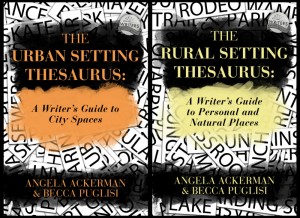
Well, there's some good news on that front. Two new books have released this week that may change the description game for writers. The Urban Setting Thesaurus: A Writer's Guide to City Spaces and The Rural Setting Thesaurus: A Writer's Guide to Personal and Natural Spaces look at the sights, smells, tastes, textures, and sounds a character might experience within 225 different contemporary settings. And this is only the start of what these books offer writers.

In fact, swing by and check out this hidden entry from the Urban Setting Thesaurus: Police Car.

And there's one more thing you might want to know more about....

Rock_The_Vault_WHW1Becca and Angela, authors of The Emotion Thesaurus, are celebrating their double release with a fun event going on from June 13-20th called ROCK THE VAULT.

At the heart of Writers Helping Writers is a tremendous vault, and these two ladies have been hoarding prizes of epic writerly proportions.


A safe full of prizes, ripe for the taking...if the writing community can work together to unlock it, of course.

Ready to do your part? Stop by Writers Helping Writers to find out more!

Yes, the ladies have a fun contest going to celebrate their new releases. As well as being a fun and innovative launch idea, it's also a great way for writers to connect with other writers on Instagram or Twitter. Check out the #myfavoritethesaus hashtag to find out more. 

(If you don't remember what a hashtag is, remind yourself by rereading recent posts on Twitter and Instagram).

Friday, 17 June 2016

A Debut Book Launch Party - Kara Isaac

This year has been a year of firsts. My debut novel, Close To You, released in April and then I had my first ever book launch in late May to celebrate. I thought I'd share a few photos of the event which was held in Wellington, New Zealand with about 70 friends and family a few weeks ago :) 


My sister and in-laws flew in from Australia and my grandmother from out of town :)


A trope of singing elves made a surprise appearance


I thanked a LOT of people but probably not nearly all everyone who deserved it!


I had never been to a book launch in my life but I was informed two things were compulsory - signing books and doing a reading. So I signed a lot of books :)


And my husband did a reading in an indeterminable accent that had definite mafia undertones :)

I had an amazing night, tumbled into bed shortly after midnight only for the two-year-old to decide that the next day should begin at 5am! Alas, the budget for my next book launch in October isn't nearly as healthy (and I'll be eight months pregnant!) so I'm going to have to come up with some new ideas! Have you ever been to any book launch parties? What are your favourite things?

Kara Isaac lives in Wellington, New Zealand. Her debut romantic comedy, Close To You, is about a disillusioned academic-turned-tour-guide and an entrepreneur who knows nothing about Tolkien who fall in love on a Tolkien themed tour of New Zealand. When she's not working her day job as a public servant, chasing around a ninja preschooler and his feisty toddler sister, she spends her time writing horribly bad first drafts and wishing you could get Double Stuf Oreos in New Zealand. She loves to connnect on her website, on Facebook at Kara Isaac - Writer and Twitter @KaraIsaac


Thursday, 16 June 2016

Book Review Heart of a Cowboy

By Jenny Blake

Mountain Brook Ink (March 1, 2016)

Hearts in Pursuit 
By Susan Page Davis 
Can Abby and Sam fight their way through the danger and violence and live long enough to find love? 
Texas, 1880. Abby and Sam pursue a band of raiders to rescue their younger siblings. Abby’s father is gravely injured, and she knows she can’t return home without her little sister. Sam’s father wants to thwart his powerful Mexican father-in-law and stop him from taking Pablo to live with him south of the border, but once he has Pablo back, will he continue the search for Abby’s sister? Abby and Sam feel it is up to them to keep the recovery mission on track. Though romance seems to have no place on the trail of danger and violence, can this journey draw them closer? 

Hearts Reunited 
By Miralee Ferrell 
Mercedes Taylor is determined to save her ranch after her father’s death, but she won’t let anyone help—especially not her old friend Jesse Townsend who deserted her so many years ago. The pain his family inflicted on hers goes too deep for her pride to forgive. 

After riding the trail for five years, Jesse Townsend returns to his family property to find the girl he’d once loved all grown up—and more prickly than he’s ever seen her. After his mare is seriously injured, he has no choice but to call on Mercedes—the local animal doctor—for help. 

Add the attractive banker’s daughter who Jesse seems smitten with, and trouble starts brewing. Can Mercedes and Jesse set aside the old family feud and find their way back to the love that had only started to blossom when Jesse left? 

Have Dress, Will Marry 
By Yvonne Lehman 

Julie Hayes must escape from Wildcat Mountain. Her mother died, leaving her with a step-father she doesn’t trust. 
James, who she thought would be her means of escape, is gone. Her only hope is to approach the cowboy, saddleback preacher Timothy Sullivan, when he makes his circuit into Wildcat Mountain. She asks, “Will you marry me?” He says, “Yes, of course,” expecting to perform a ceremony for her and James. 
Believing Julie is in danger, Timothy takes her to the Sullivan Ranch. Suspicions abound when she’s accused of stealing a horse and jewels. 
While Julie is trying to become the kind of woman a preacher would want to marry, Tim is trying to realize his ranching dreams, which don’t include being a circuit riding preacher. 

The Hand-Me-Down Husband 
By Vickie McDonough 

Ellen Stewart despises Lance Garrett. If not for him dashing into Isabelle’s life and stealing her heart and filling her head with his dreams, her little sister would still be alive and safe at home. When she receives Lance’s letter requesting help, Ellen rushes to Silver Springs, intent on taking charge of her young niece. A rugged ranch is no place for a motherless baby. But when she realizes the depth of Lance’s despair, she can’t leave him alone. Though everything within her wants to flee back to the big city, something makes her stay. Tessa needs her father, for one—and he needs her. Ellen knows what it’s like to lose all she’d dreamed of. When local church members make a stink about Ellen living at Lance’s ranch, they are forced to marry. Ellen didn’t want a hand-me-down husband, but could their marriage be God’s will for them both? 


My Review:
I was given this book free for an honest review.

This book contains 4 novella's each featuring cowboys. 
The first had me from the very beginning. In fact I could see it as a movie, a true western. Abby's younger sister Ellen and Sam's younger brother Pablo are taken by Mexican Raiders planning to take them to Mexico. I could see the story playing out as a movie and loved Abby's strength and courage. This story was a great start to the novella.

The second book features Mercedes and Jesse childhood friends who due to an incident led to the families becoming estranged. We see Jesse return to his ranch needing Mercedes help. We then see the struggle of being former friends with still having feelings for each other and how they deal with it.

Book Three features Julie and Timothy. Julie is stuck on living on a mountain with her step father and asks Brother Timothy to help her in an unconventional way. Timothy is the circuit pastor who wants to be a rancher. Julie learns what a real family is like when she meets Timothy's family but there are issues with trust and accusations by her step father.

Book four features Ellen and Lance. Ellen has gone to help Lance look after her niece after the death of her sister. She goes to help wanting to take her niece back to St. Louis with her but see the love Lance has for Tessa. I love how Ellen and her sister were so different and how she is able to help Lance and in turn learn more about herself and that she does have a purpose. 

All in all this is a good collection of novellas which I would highly recommend.