Pages

Showing posts with label Paula Vince. Show all posts

Thursday, 9 November 2017

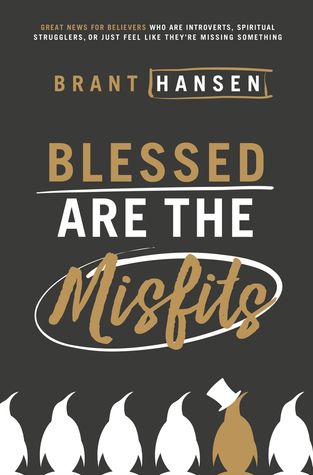
Book Review - Blessed are the Misfits by Brant Hanson

34460639

In his unique style, Hansen looks to answer questions that millions of people carry with them each day:

If I don’t relate to God as emotionally as others do, is something wrong with me?
How does one approach God, and approach faith, when devoid of the “good feelings” that seem to drive so much of evangelical church culture?
How does God interact with those who seem spiritually numb?
Is the absence of faith-based emotion a sign of that God has moved on or was never there?
What if we aren’t good at talking to people about our faith, or good at talking to people at all?
What if I’m told I’m too analytical, that I “think too much”?
Where does a person who suffers from depression fit in the kingdom? Is depression a sure sign of a lack of faith?
This book is good news for people who are desperately looking for it. (And for their loved ones!)

It’s also for those who want to believe in Jesus, but inwardly fear that they don’t belong, worry that don’t have the requisite emotion-based relationship with God, and are starving for good news.

Blessed Are the Misfits is going to generate discussion, and lots of it. It’s simultaneously highly provocative and humbly personal. It’s also leavened with a distinct, dry, self-effacing humor that is a hallmark of Hansen’s on-air, writing, and public speaking style.


MY THOUGHTS:
A huge thanks to Brant Hansen for writing this book, because the sort of misfits he's talking about are probably more common than any of us realise, but each keep quiet to save face. I can relate to several of his points. We hesitate to confess our misfit status because we may feel inferior, and imagine that we lack some sort of spiritual backbone. Even when we've prayed, striven and tried hard to fix ourselves for years, the deficiency still seems to be connected with us failing to measure up. Especially when we see our outgoing, full-on and super-spiritual friends and family doing what seems to come so naturally to them.

This book is for the sorts of Christian misfits, oddballs and introverts who often feel we don't fit into what he calls the typical American church culture (or Australian by extension, in my case). When people talk about sensing God's loving arms wrapped around us during worship... well, some people just don't. Preachers and counselors urge everyone to 'open up to the spirit' or 'stop leaning on our intellect' but there are those who can't effect any change. And some find praying is a bit like talking into a dead walkie-talkie. Hansen is a Christian radio personality who can relate to all this, and his book convinces us to stop feeling as if we belong on the 'Island of Misfit Toys of the kingdom.' Quieter, head thinking types of Christian can honor God just as faithfully as our more emotionally switched-on friends. What a relief.

He drops the names of some surprising people who counted themselves among the unfeeling faithful. Their lives bore real fruit, which is not the same as incredible spiritual experiences, wordy prayer times or impressive ministries. It's simply love, joy, peace, patience, kindness, goodness, faithfulness, gentleness and self-control.

I appreciate how Hansen gently puts to rest some issues which may have the potential to give us colossal guilt trips, such as failing to live up the the Great Commission or being unable to aspire to warrior type prayers. In a nutshell, Mark 16:15 wasn't necessarily meant the same way for everyone by Jesus, and even fumbling, ten-second prayer efforts have great potential.

There's some lovely encouragement for the unnoticed, who may think they're consequently not worth as much as those in the spotlight. It's a reminder that we needn't look where everyone else is, because God operates a lot in the margins, and tends to nurture unobtrusive mustard seeds, sparrows and lilies of the field, while we're admiring lions and peacocks on the stage.

Lifting this weight of false guilt and unnecessary expectations off our shoulders is a great enough reason to read the book, but Brant Hansen also gives sound tips about how to face it whenever it creeps back, as it inevitably will. Developing the habit of ignoring our harsh and false inner monologue, and even challenging it as a liar, may do us a world of good. With the help of friendly books like this, I dare to believe it is possible.

Thanks to Thomas Nelson Publishing and Net Galley for my review copy

Paula Vince is a South Australian author of contemporary, inspirational fiction. She lives in the beautiful Adelaide Hills, with its four distinct seasons, and loves to use her environment as settings for her stories. Her novel, 'Picking up the Pieces' won the religious fiction section of the International Book Awards in 2011, and 'Best Forgotten' was winner of the CALEB prize the same year. She is also one of the four authors of 'The Greenfield Legacy', Australia's first and only collaborated Christian novel. Her most recent novel, 'Imogen's Chance' was published April 2014. For more of Paula's reflections, you may like to visit her book review blog, The Vince Review.


Wednesday, 27 September 2017

Do you finish every book you start?


I've heard excellent cases for both sides of this one. To be honest, I was conditioned not to read every word during my time at Uni when I was studying English, and we were given way more books in the syllabus than we could possibly read. It seemed impossible to cram in one per week, when we were talking about novels the size of Little Dorrit, Bleak House or Middlemarch. The staff surely knew we'd focus on our essay topics and skim through the rest, but was it a good habit they were molding us into? Here are some pros and cons for both sides.


I Finish Every Book

These are the people who grit their teeth and plow through no matter what. They believe being faithful in small commitments proves them more likely to be faithful in larger ones. Quitting in small matters, such as reading a book, makes them more likely to be quitters in life.

One lady wrote that she can't count the numbers of times she was bored at the beginning of a novel and wowed by the end. Sticking to a book, in her opinion, is its own reward. She reminded me of times I've loaned books to people who I'm sure would have enjoyed the story if they'd only persevered.

J.R.R. Tolkien wrote, "I've only abandoned three books that I can remember, preferring to soldier on through unmemorable chapters than to let an unfinished plot clutter my thoughts." He'd probably be aghast by this superficial skimming era we find ourselves in, and perhaps he'd have a point. What can be more shallow than making snap judgments about any given book based on first impressions?

I Don't Bother Finishing Every Book

These people may be aware of statistics. Google says there are nearly 130 million books in circulation in the world, and 4500 are published in the USA alone, daily. A person who commits to completing 50 books in a Goodreads challenge each year, would have to read for a century to tap into 0.00004% of them.

As the years are short and fly by so fast, and there are many books we'd enjoy far more just waiting to be discovered, what is the point of slogging on with a book which isn't engaging us? It simply wastes the precious time we could be spending on those which could be a far better fit.

My Point of View

I probably side more with the non-finishers. I believe in giving books a fair, fifty page trial, but by then, you've probably developed a fair idea of whether you should keep going. I've stuck to books I've been forced to study. In more recent years, I also try to stick to books I've committed to review for blogging programmes such as Net Galley. This has been enough to show me that the first third of any given book is usually enough to help form an accurate, overall impression.

If it's a novel, and the characters are flat and the plot creeps along like a tortoise, it probably won't get much better. I've read a lot of books in my lifetime, and generally find that if I'm going to like them, I'll be engaged from the start ninety percent of the time.

Many of us used to complain about having to read books we hate at school, just so we can churn out boring essays about them. Some of these school novels left us with bad after-tastes about perfectly good authors for years. Well, the good news is that in most cases, nobody is forcing us stick with unenjoyable books any more. I'd encourage more people to appreciate and use the freedom of no longer being in school.

If you need somebody to give you permission to quit a book you're finding tedious, maybe I can be that person. Although the books may feel like people, they are only books. It's not as hard as breaking up with somebody you're dating. If it's not making you look forward to your next spare moment when you can pick it up, then drop it. If you don't daydream about it and want to rave about it and shout about it from the rooftops, it probably doesn't matter if you don't finish it. I don't agree with Tolkien about letting unfinished plots clutter my thoughts. If I'm finding them hard going, I'm more than happy to let them disappear from my thoughts completely.

So take it back to the library, donate it to a Goodwill shop, delete it from your kindle and get on with something good.

Paula Vince is a South Australian author of contemporary, inspirational fiction. She lives in the beautiful Adelaide Hills, with its four distinct seasons, and loves to use her environment as settings for her stories. Her novel, 'Picking up the Pieces' won the religious fiction section of the International Book Awards in 2011, and 'Best Forgotten' was winner of the CALEB prize the same year. She is also one of the four authors of 'The Greenfield Legacy', Australia's first and only collaborated Christian novel. Her most recent novel, 'Imogen's Chance' was published April 2014. For more of Paula's reflections, you may like to visit her book review blog, The Vince Review.

Thursday, 14 September 2017

Book Review - 'Every Job a Parable' by John Van Sloten

35487139

A Walmart greeter, a nurse, and an astronaut walk into a church. . . .

They each bring with them their own exhaustions and exasperations, their own uncertainty about whether and how their work matters to God. Good news: All work matters to God, because all work reflects some aspect of the character of God. God created the world so that it runs best when it mirrors Him, and we ourselves find the most fulfillment when we recognize God behind our labor.

John Van Sloten offers a fascinating and innovative reflection on vocation: Our work is a parable of God; as we work, we are icons of grace.


MY THOUGHTS:
This is a great read for anyone who finds their daily grind a bit of a drag, or can't help thinking of their spiritual self as separate from their daily, nine-to-five self. John Van Sloten believes we can stretch our minds to think of any job or occupation as a parable for the way God works. After all, he's always made himself known through real people doing real work.

First, Van Sloten knocks down the vocational hierarchy we might have all bought into at different times. It simply doesn't exist from a heavenly perspective, where every humble job has its own dignity and significance. Throughout the book, he interviews and observes people in many different professions, and then has fun revealing their essential goodness to them. To mention just a few, there are astronauts, flyer-deliverers, psychologists, residential landlords, cleaners, electricians, automative repairmen, florists, language translators, geophysicists and hairdressers. It's great to think we're all on an equal plane.

We are urged to study God's signature moves, so we can more easily notice the way our jobs reflect them. Then we can pull our attitudes about them back into sync, in case they've been a bit off. There are three roles I've held; cleaner, writer and parent, which many people can probably relate to, and I enjoyed reading the thoughts about them.

Cleaners (including anyone who cleans or regularly tidies up messes) reflect God's heart for people to have clean and healthy lives. We remove unnecessary, used trash to make room for pristine new surroundings, which is what God does on a larger scale. Cleaners everywhere bear witness to his world-restoring power, whenever we leave anything better than how we found it.

As writers, we share God's heart for creativity, and attempt to figure out the way his world works through story telling, and clarity of expression. Pondering how we're going to form our sentences allows us to catch glimpses of God's own thoughts, and spread them, for the things we're passionate enough to write about are often the things he's passionate about too.

And needless to say, as parents we enter into God's heart to care, nurture and love each others with a giving, sacrificial love.

It's a mood-lifting book to read, with plenty of cheerful ways to regard the things we might not feel all that cheerful about naturally. John Van Sloten is aware that in our darker moods, this may all come across a bit platitudinal. He advises us to keep stretching our broader perspective muscles to go with it anyway. I think it really does work, and if you look for your own job, you'll be quite likely to find it in this enthusiastic and comprehensive book.

Thanks to NetGalley and Tyndale House for my review copy.

Paula Vince is a South Australian author of contemporary, inspirational fiction. She lives in the beautiful Adelaide Hills, with its four distinct seasons, and loves to use her environment as settings for her stories. Her novel, 'Picking up the Pieces' won the religious fiction section of the International Book Awards in 2011, and 'Best Forgotten' was winner of the CALEB prize the same year. She is also one of the four authors of 'The Greenfield Legacy', Australia's first and only collaborated Christian novel. Her most recent novel, 'Imogen's Chance' was published April 2014. For more of Paula's reflections, you may like to visit her book review blog, The Vince Review.


Friday, 28 July 2017

Do you enjoy reading aloud?

When it comes to driving a car, I refuse to have my husband as a passenger. Even when I've gone to pick him up from somewhere, I prefer to slip across to the passenger's seat and let him get behind the wheel. He's just better at it than I am. He has a perfect sense of direction and finely-tuned reflexes. But most of all, when I drive he clutches the sides of his seat and looks agitated, making digs about how bad I am. He's simply the best person for the job. In the same way, when it comes to reading stories out loud, I believe I'm the best person for the job.

When we first got married, we headed off on a holiday with a trilogy of novels to read together. We'd intended to take turns reading, but it quickly became clear that he wasn't the right person to do it. He was too erratic, often pausing to figure out words he felt tough to get his tongue around. Sometimes, he was so busy just trying to read sentences out loud that he had to pause to glance over them again for their sense of meaning which interrupted the flow. It didn't take long for him to decide that as I enjoy reading out loud, I could do it permanently. I was happy with the deal, as I'd been reading out loud since I was very small, to any captive audience. It was most often my mum.

Since then, I've had years of opportunities, as I've been homeschooling our three kids. To be honest, I'm not keen on being on the other side of the book and listening. I like to have control. I can choose the right inflections to use in different characters' voices and use accents if possible. I get to utilise dramatic pauses at moments I choose, and emphasise whatever I want to, whether or not it's written in italics. I have some degree of control over how I want my listeners to feel about the characters, as it all comes out in the delivery. I love to be the person who knows what's coming, to anticipate the surprise on my listeners' faces, the gasps of shock or bursts of laughter. Not least, I appreciate it when one of the kids comes to me holding the book, saying, 'It's time to hear another chapter.'

This hobby isn't everyone's cup of tea. I had to smile as I thought of three famous novels in which an unwilling young character is coerced (or forced) into reading out loud to an antagonistic elderly person.

1) Little Women. Jo is a hired companion to rich, crabby old Aunt March (who is actually her great aunt). It's a hassle for poor Jo to be pinned down to a seat, reading the dry old books Aunt March wants to hear. The main thing which helps her bear it is that she can duck into the library to find a book of her own choice for silent reading when the old dame nods off.

2) The Book Thief. Young Liesel Meminger manages to soothe the angst and panic of the neighbours on her street, as they huddle in the bomb shelter, dreading what might happen suddenly. She considers herself to be handing out words, but doesn't expect mean old Frau Holtzapfel, who spits on their door, to come knocking, asking for Liesel to come and keep reading to her in the privacy of her own home. To Liesel's dismay, her mama, Rosa Hubermann, agrees, as Frau Holtzapfel promises to stop the spitting, and to hand over her coffee ration in return.

3) To Kill a Mockingbird. Jem Finch is ordered by his father, Atticus, to read to bedridden, nasty old Mrs Dubose. There is no way he can wriggle out of it, as it's ostensibly his punishment for losing his cool and going berserk in her garden. Even though she behaves very strangely during the reading sessions, not until later does Jem discover the real reason for her request. I'm sure his reading probably did help distract her.

Even though these three situations appear less than ideal on the surface, they show the power inherent in reading out loud, evident in the creation of truces and ties which weren't there in the first place. The power of a good story breaks down walls and barriers between people who, on the surface, are very different. The act of a reader and listener sharing an author's intentions and inspiration is an excellent way to promote good feeling between them, even when it wasn't there to start with. And I'm sure Jo, Liesel and Jem would all look back on those reluctant sessions with nostalgia. Jem's little sister, Scout, who went along for moral support, certainly did.


So I like to be the reader, and my husband and children prefer to be listeners. When it comes to reading aloud, which end of the book do you like to find yourselves?


Paula Vince is a South Australian author of contemporary, inspirational fiction. She lives in the beautiful Adelaide Hills, with its four distinct seasons, and loves to use her environment as settings for her stories. Her novel, 'Picking up the Pieces' won the religious fiction section of the International Book Awards in 2011, and 'Best Forgotten' was winner of the CALEB prize the same year. She is also one of the four authors of 'The Greenfield Legacy', Australia's first and only collaborated Christian novel. Her most recent novel, 'Imogen's Chance' was published April 2014. For more of Paula's reflections, you may like to visit her book review blog, The Vince Review.

Friday, 23 June 2017

Euphemisms - friends or foes?

I shared a similar post on my own blog a long time ago, and thought I'd share it here too. Euphemisms are such a common feature of speech or writing that we often no longer even recognise them as such. Are they handy tools to use in our writing, or should they be as mercilessly weeded out as their cousins, the cliches? Do they enhance our passages or obscure them? Do they soften the bluntness of what we intend to say, or simply create confusion and unnecessary nonsense? These are some of the questions we must ask ourselves.

A euphemism is a roundabout way of expressing something to soften the impact, because the most direct way may be considered too blunt or offensive. At first I assumed many euphemisms might have disappeared with the Victorian era. Those were the days when ladies' sensibilities were fashionably delicate, and even table and piano legs were covered for modesty. However, euphemisms are still flourishing, even in the twenty-first century. So much so that we might not even realise when we are using them. Here are some examples.

Euphemisms that are intended to soften the blow.
a) John is a bit long in the tooth to play football with the boys. (He's old.)
b) Peter is a bit light on top for that sort of hairdo. (He's bald.)
c) The soldiers were killed by friendly fire. (One of the most ironic and sad euphemisms of all, for bureaucratic botch-ups.)

Euphemisms that give rise to others
Bob is visually challenged. (In other words, he's blind, but short people may take it on board and jokingly refer to themselves as 'vertically challenged'.)

Euphemisms that are no longer recognised as such.
Eddie slept with Sue. (Okay, we all know what this really means.)
Mary is carrying a few extra kilos. (You mean she's overweight.)
I'm afraid I had to let David go. (He was fired. The connotation of this euphemism makes it sound as if the employer is doing David a favour.) 

Euphemisms that may be as hurtful or worse than the most direct expression.
Roger is just a couch potato. (The imagery is so ruthless, the word 'lazy' may be less insulting.)
The twins' grandma has lost her marbles. (Would the word 'dementia' be any unkinder?)


Those euphemisms are closely connected to my favourite.

Euphemisms that have become so over-used, they now have euphemisms of their own.

The word 'toilet' is a prime example. In the olden days, polite people didn't want to say where they were headed, so they resorted to this euphemism. A 'toile' was an old-fashioned French word for a piece of cloth which ladies placed around their necks while they were getting ready for social eventsAs a kid, I didn't know this. Whenever I came across a sentence, such as, 'Josephine set off to do her toilet,' I'd think, 'Too much information. Why do we need to know that?' Then one day, it dawned on me that she was actually sitting at her dressing table with her wash cloth and make-up.

So it became a euphemism for the you-know-where (another euphemism), all tied in with cleanliness and grooming. But now what's happened? After decades of being over-used, the word has lost its edge. It's come to stand for what it really is. People now think of several different ways of saying it.

'Can you point me to the bathroom?' (Being an Aussie kid, I used to think, 'Yuck, who'd want to wash themselves in there?)  We hear it called the rest room, the John, the lavatory/lavvy, the loo, the dungeon, the dunny and the little boys'/girls' room.

The future of euphemisms 

I can't help thinking that if cliches are menaces, euphemisms may be more so because they are more sneaky. They masquerade as something sensitive and good, yet carry the same tired old baggage as cliches. I can't help wondering whether people from foreign cultures who are trying to learn English get crazily mixed-up, trying to figure out whether or not our expressions are literal. (Is now the time to complain about his cold feet? He only needs to wear warm socks beneath his shoes when he walks up the aisle to marry her.)

However, euphemisms have ancient origins, and having been around for so long, are no doubt here to stay. Even Jesus used euphemisms. He told his disciples, 'Our friend Lazarus sleeps, but I go to wake him up.' Being a bit obtuse when it came to picking up on subtleties, they said, 'Lord, if he sleeps, he will get well.' Just to make it crystal clear, in case we're slow like the disciples, the Bible tells us, 'Jesus spoke of his death, but they thought He was speaking about taking rest in sleep.' Next, Jesus told them plainly, 'Lazarus is dead.' It's not difficult to imagine Him rolling His eyes. (This incident takes place in John 11: 11-15.) 

It all begs the question, if many euphemisms tend to be silly and pointless, is saying the real thing preferable? What do you think? Are euphemisms our friends or our foes?


Paula Vince is a South Australian author of contemporary, inspirational fiction. She lives in the beautiful Adelaide Hills, with its four distinct seasons, and loves to use her environment as settings for her stories. Her novel, 'Picking up the Pieces' won the religious fiction section of the International Book Awards in 2011, and 'Best Forgotten' was winner of the CALEB prize the same year. She is also one of the four authors of 'The Greenfield Legacy', Australia's first and only collaborated Christian novel. Her most recent novel, 'Imogen's Chance' was published April 2014. For more of Paula's reflections, you may like to visit her book review blog, The Vince Review.

Thursday, 25 May 2017

Book Review - The Spirituality of Jane Austen, by Paula Hollingsworth


Best known for her novels Pride and PrejudiceSense and SensibilityMansfield Park, and Emma, published anonymously, Jane Austen commented, critiqued, and illuminated the life of the British gentry at the end of the 18th century. But did Jane’s writings highlight anything about her own spirituality?  In this celebratory book, Paula Hollingsworth explores Jane Austen's gentle but strong faith and the effect it had both on her life and her writing.

MY THOUGHTS:
This book delves into the personal faith of one of the world's most beloved British novelists, drawing from her own correspondence and personal writing. It also examines the deeper mindsets and attitudes of characters in her novels for clues of what their creator really felt.

Jane's own faith is an interesting question, considering her cheeky portrayal of clergymen in her novels, such as the pompous, servile Mr Collins, and the snobby, social climbing Mr Elton. We can't help wondering whether they were proof that she deplored the Christian faith, or if she simply considered that they represented a different brand of Christianity to hers.

Jane Austen's fondness for reading printed sermons, and some of her own written prayers indicate that she was a devout believer in her own quiet way. So do the guiding principles of her main characters. For example, I love the idea that the retiring Fanny Price actually serves the role of Old Testament prophet or seer in the novel 'Mansfield Park.'

It's revealed in these pages that Jane didn't appreciate the evangelical movement or the behaviour of its spearheads, such as John and Charles Wesley. It seems she objected to their emphasis on dramatic conversion experiences, and the sense of superiority it seemed to suggest. For Jane Austen, matters of faith should be strictly between the individual and God. She didn't think highly of the evangelical novelists of her day. In her opinion the Christianity they presented in their stories was too showy and in-your-face, although she used less modern expressions. It's all very interesting, and makes me pretty sure that if she'd been born in our time, she'd probably choose to write for the secular market, just as she did in her own.

I like the glimpse of the popular novels of her Regency time period. They tended to be either Gothic or Romantic Sentimental, neither of which was approved reading for young ladies. They were regarded as frivolous and even dangerous, but the Reverend George Austen gave his daughters uncensored access to his personal library of over 500 volumes, which did include recent hyped-up best sellers.

These days, Austen fans tend to think of him as a good dad, but back then, the majority might have thought differently. I couldn't help comparing his situation to a current question I've seen often going around, of whether conscientious parents should put filters on their kids' internet, or even forbid it altogether. I've come across parents who do either one or the other, although we never did either in our household. It makes me think we were following in the footsteps of the Austens. I love how they were self-proclaimed, unashamed novel readers, in their day and age. Jane has her 'Northanger Abbey' hero Henry Tilney declare, 'The person, be it gentleman or lady, who has not pleasure in a good novel must be intolerably stupid.'

Altogether, if you don't mind a fair bit of her plots being re-told, this is a good read with some interesting detail for any fan. Not only does it give another good glimpse into Jane Austen's family life, but gets us reconsidering our own attitudes alongside those of Jane and her family.

Thanks to NetGalley and Lion Hudson for my review copy.

Paula Vince is a South Australian author of contemporary, inspirational fiction. She lives in the beautiful Adelaide Hills, with its four distinct seasons, and loves to use her environment as settings for her stories. Her novel, 'Picking up the Pieces' won the religious fiction section of the International Book Awards in 2011, and 'Best Forgotten' was winner of the CALEB prize the same year. She is also one of the four authors of 'The Greenfield Legacy', Australia's first and only collaborated Christian novel. Her most recent novel, 'Imogen's Chance' was published April 2014. For more of Paula's reflections, you may like to visit her book review blog, The Vince Review.

Thursday, 13 April 2017

Book Review - The Kindness Challenge by Shaunti Feldhahn

29794691

Think of your toughest relationship. Think of a relationship that is good but could be great. Think of a group of people that drives you nuts. You want to show more kindness and generosity, but sometimes you’re just tired, stretched, and frustrated. Besides, would small actions make that big a difference? Yes!

After years of extensive research, Shaunti Feldhahn has concluded that kindness is a superpower. It can change any relationship, make your life easier and better, and transform our culture. But how does it work? And how can you show kindness when you don’t feel like it?


MY THOUGHTS:
Shaunti Feldhahn is a Christian author and speaker, and this is just what the title says it is, a 30-Day Kindness Challenge, if you want it to be. And if you don't want to take part in anything quite that formal (I'm not a one-size-fits-all sort of person myself), there are tips, anecdotes, suggestions and stats all through the book which you can pick and choose from. I'll just mention some of the ones which stuck out most to me.

One of the most common themes of my reading lately is that we have to watch our thought lives. It's what you put into your mind and focus on that will come out of your mouth. This book is no exception.

It seems many of us might live under the delusion that we are kinder people than we actually are. I can buy that. A few interesting stories indicate that we tend to be more reactive and irritable than we think we are. I'm probably guilty of that around my place at times (very rarely, lol), since family members may pick up on my grouchiness quicker than I even acknowledge it to myself.

Feldhahn talks about the argument that we may need to vent our spleen to let off steam. I'm sure we're all familiar with the line of reasoning. What's inside has to come out, or it festers and swells, and the person eventually bursts with all their repressed annoyances and complaints. That always sounded fair enough to me, but it does seem to contradict the idea that we should always make kindness a habit. I wondered how Shaunti Feldhahn would tackle it. Well, she believes that giving the grumbles head space in the first place is the main problem. Anything we choose to just shrug off and refuse to acknowledge doesn't grow bigger, but withers up and dies for lack of being fed. In other words, when it comes to kindness, 'Fake it til you make it' is a more suitable motto than, 'Better out than in.' It's an interesting view that I quite like.

She addresses the subject of sarcasm, and I was pleased that she distinguished between what she calls good-natured trash talk, and truly ill-natured remarks designed to hurt. It was more realistic sounding than advice to avoid sarcasm at all costs would have been, which I have come across before. My family would suffer if we were never allowed to use sarcasm. I've heard it called the lowest form of wit, but it does cheer us up at times, and defuse tense situations.

Now, can you critique a book about kindness kindly? The thing with book reviewers is that we're open to finding new ways of not coming down too hard, but I did have a couple of gripes. My first is that are bullet points everywhere. I think there are even bullet points within bullet points. I actually like lists, but they get to a point where they lose their effectiveness and stop being memory tools, when we're inundated with them. And you don't necessarily even need them all. Some self-help books slide into condescension, and this had moments of heading in that direction. For example, do we really need a list of possible ways of giving praise to family members? Surely we know our own spouses and kids better than she does, and have enough imagination to come up with our own praise points.

Some of her points about praise were good though. Some people believe we shouldn't bother saying thanks to a person for things they're supposed to do, because it's their job. But I agree with Feldhahn, that when we do, it's like filling a fuel tank, and prevents those people feeling like they're being taken for granted. It's this sort of small consideration which might actually turn out to make an enormous difference. Overall, it's not a bad read which may make us realise we're not as kind as we thought we were, and offer tips to give us an edge in the art of kindness.

Thanks to Waterbrook Press and Blogging for Books for giving me a review copy through NetGalley


Paula Vince is a South Australian author of contemporary, inspirational fiction. She lives in the beautiful Adelaide Hills, with its four distinct seasons, and loves to use her environment as settings for her stories. Her novel, 'Picking up the Pieces' won the religious fiction section of the International Book Awards in 2011, and 'Best Forgotten' was winner of the CALEB prize the same year. She is also one of the four authors of 'The Greenfield Legacy', Australia's first and only collaborated Christian novel. Her most recent novel, 'Imogen's Chance' was published April 2014. For more of Paula's reflections, you may like to visit her book review blog, The Vince Review.

Friday, 7 April 2017

Changing Seasons of Writing

For the last couple of years, I've been having trouble settling down to write a new novel. Since the nineties, I used to rip right into them very quickly, but that feeling of eureka in the planning stage has been eluding me. I would find that even when I devised plans which might have some merit, I couldn't force my enthusiasm to jump on board to the extent it used to. Since that sense of fizzing anticipation was once my green light, I didn't want to move without it. I knew there wouldn't be much point anyway. That strong drive to woo others to share my love of my plots and characters had been my motivator.

For some time, it distressed me if I thought about it too hard. I thought I had a case of writer's block, and faced all the frustration and loss of identity that went with it. Acquaintances would ask, 'What book are you working on now?' and I'd mumble something about sifting through ideas. On one hand, I really wanted my mojo back, but on the other, it was nice to have a break from all the emotional energy it took, which I'd been drawing from for several years, and one project after the next. Because my characters often had some pretty tough issues going on.

Anyway, this photo of my local wetlands in the summer heat seemed an accurate picture of what I thought my creative mind resembled then. A desolate looking dust bowl. But I didn't want to admit it to anyone.


Then one day it struck me that I was still writing the same volume anyway. The writing pads and pens I was flying through were still the same as before, and so were the number of hours I'd sit at my computer typing. I assumed I'd developed writer's block, but I was simply writing different things. One was a factional account of my grandfather's life, based on the prolific notes my Dad had asked me to type for him. I also wrote lots and lots of blog posts, including numerous lists and reflections about reading and writing. The source of my writing hadn't dried up at all. It had simply changed direction, at least for a period of time. I guess it can happen.

In fact, when it comes to ideas for blog posts, my mind is like this. The exact same spot, but during last year's floods. And that water got even deeper, so you couldn't see the bridge at all, because it was completely submerged.

I understand marketing advice to be clear about our personal brands, so we can convey them to the general public and our target audience. And I'm loving the new genre series, which are cross posted on this blog and Christian Writers Downunder. Passionate authors with a wealth of experience in what they write are sharing the wisdom they've gleaned over many years. I look forward to each new one, and the interesting details we might learn. Yet at the same time, I've been learning that I need to be flexible enough not to get so set in my own rigid decisions about what I write that I close myself off from the Holy Spirit's gentle nudges. Fearing that my writing time might be over, just because I wasn't working on a novel, was my own idea, and not necessarily God's.

At the moment, I'm considering the possibility that there may be no more contemporary Christian dramas from me. They might be a season of my life that really has dried up. Perhaps some things are for a particular time, and then a drive to move on to something else catches up with us. Maybe our spiritual antennae should be always primed to pick up new possibilities in the air. It makes a lot of sense that since we're all different, something which might be a lifelong mission for one person could be stepping stones for another. And of course, the outcomes that eventuate may be way different from the outcomes we plan anyway. (Of course I won't say that I'll never, ever write another one, because by the same token, I might be wrong. Some day a new idea might come.)

Author and doctor Rachel Naomi Remen wrote a personal testimony in her book, Kitchen Table Wisdom. It's a long time since I read it, but it went something like this. She'd planted a wonderful rose garden, intending to enjoy the blooms from a particular room of her house for many years to come. One morning, she glanced out the window to see a magnificent buck (male deer) standing in her rose garden, munching her new rose buds with great relish. He was so stately and majestic, with his spotted hide and elegant, spreading antlers that she couldn't help catching her breath. And something whispered in her heart, 'You thought you were planting this rose garden so you could enjoy the splashes of colour. But it turns out the real reason you planted it was so you could attract and enjoy visits from this awesome fellow and his friends and family.' And so it turned out to be.

In a similar way, I'm liking what I'm writing at the moment. I thought I started my book review blog just so I could request access to brand new releases from Net Galley. But maybe a more far-reaching reason turns out to be so I can ponder all sorts of ideas I'm getting from books, new and old, and making connections between different stories which help me see the world in ways that wouldn't have occurred to me otherwise.

And I thought I was just doing my Dad a quick favour when I agreed to type out his notes, but it turned out to be a consuming idea which gripped me for longer than I ever expected. For anyone who enjoys contrasting shots as much as I do, and what the great outdoors can show us, those are a couple more glimpses of my daily walk in different seasons.

Paula Vince is a South Australian author of contemporary, inspirational fiction. She lives in the beautiful Adelaide Hills, with its four distinct seasons, and loves to use her environment as settings for her stories. Her novel, 'Picking up the Pieces' won the religious fiction section of the International Book Awards in 2011, and 'Best Forgotten' was winner of the CALEB prize the same year. She is also one of the four authors of 'The Greenfield Legacy', Australia's first and only collaborated Christian novel. Her most recent novel, 'Imogen's Chance' was published April 2014. For more of Paula's reflections, you may like to visit her book review blog, The Vince Review.

Monday, 3 April 2017

Exploring Genres: Portal and Secondary World Fantasy

by Jeanette O'Hagan

This year, the cross posts between Christian Writers Downunder and Australasian Christian Writers are focussing on the subject of genre. In February, Iola Goulton gave a great overview of the importance of meeting genre expectations. Last month Adam Collings explored the subgenres of space opera and superhero within the science fiction genre. This month, I will be exploring portal fantasy and secondary world fantasy.


What is Fantasy


The fantasy genre covers a wide scope of different subgenres - from stories that include supernatural elements (like the Christmas ghosts in Charles Dickens' The Christmas Carol), talking animals (The Wind in the Willows or Beatrix's Potters' Peter Rabbit), magic and/or mythological creatures such as unicorns, centaurs, mermaids or dragons. It may occur in the past (the 'once upon of time' of most fairy tales), in our present (urban fantasy and many paranormal stories) or occur in an alternate reality (Alice in Wonderland) or an entirely different world separate from our own (like Lewis' Narnia or Tolkien's Middle Earth).

Much of children's literature includes fantastical elements. And while fantasy can be escapist, it often uses analogy and metaphor to explore genuine issues in the real world in subtle and illuminating ways. Maybe because we know this is not the world we live in, we are more willing to explore those issues without the prejudices of our own world.

With the rise of modernism, fairy tales and the fantastical was falling out of favour for a more materialistic approach to literature, especially by the mid-20th century. Arguably, it was the influence of two Christian authors that rebooted the interest in fantasy - C S Lewis with his heart-warming Narnia series and J R R Tolkien with his iconic The Hobbit and its sequel The Lord of the Rings. It just so happens that Lewis wrote a portal fantasy, Tolkien a straight secondary world fantasy.

Portal Fantasy

Sky Bridge, water colour by Jeanette O'Hagan 2016
(inspired by Rachel Sutherland)


In portal fantasy, someone from our normal world stumbles upon a 'portal' or door to an alternate reality where fantastical beings, powers and objects exist.  A classic example of a portal fantasy is Alice in Wonderland - when Alice chases the white rabbit down the rabbit hole and finds herself in Wonderland (a place that defines the laws of logic) or The Wizard of Oz (in this case the tornado becomes the portal). Similarly, in The Lion, the Witch and the Wardrobe, Lucy Pevensie hides in a old wardrobe and finds herself in the land of Narnia.

Portal fantasy has been quite popular as it allows the reader to see the strange new world through the eyes of an ordinary person. Imagine Wonderland without Alice. Alice helps the reader discover this strange, contradictory world through her eyes, through her questions, through her confusion. In a way, J K Rowling uses this technique with Harry Potter, who has been brought up in the mundane world with no knowledge of the magical. Portal fantasy keeps a tenuous link between the fantasy world and our own. It is possible to travel between the worlds, and each world may effect and shape the other. The journey to the other world often becomes a journey of self-discovery and heroism.

Some limitations of portal fantasy can its focus on the traveller to the new world than the world itself, and its often linear plot (the hero's quest to return home, for instance, as with the movie version of The Wizard of Oz), but this certainly isn't always the case. For instance, in Anne Hamilton's Daystar, the plot is more complex.

More recent portal fantasy by Australasian Christian authors include Paula Vince's Quenarden series, Anne Hamilton's Merlin's Wood and her award-winning Daystar and also A Swirl of Purple of Jessica Scoullar. One could argue that US author Ted Dekker's The Circle series is portal fantasy (the portal being Thomas' transition between waking and sleeping).

Secondary World Fantasy

Strange Visions, water colour by Jeanette O'Hagan
(inspired by Rachel Sutherland)


In secondary world fantasy, the world is that is separate or other than our own. (In a way, portal fantasy is a subset of secondary world fantasy - but there is still that connection between the two realities.) Classic examples include Tolkien's Middle Earth (The SilmarillionThe HobbitThe Lord of the Rings), Ursula Le Guin's Earthsea, Emily Rodda's Deltora Quest or Terry Pratchett's Discworld. The secondary world may be very different to our own (for instance, Discworld) or it may have stronger parallels with our known reality (Tolkien's Middle Earth). Sometimes, it's easy to trace the correspondence between the real and imagined worlds. George R R Martin's Westeros has clear echoes of Eurasia, specifically Great Britain - a popular choice also seen in Patrick Carr's Cast of Stones and John Flanagan's Ranger's Apprentice.  The TV series, Avatar: The Last Airbender and the follow-on, The Legend of Kora echoes Asian cultures (Japanese, Chinese, Tibetan and Inuit).

Good alternative world fantasy makes a strong investment in world building, with many aspects covered (geographical, cultural, political, technological, metaphysical, historical, magical). Plots and themes are often complex and/or epic in scale. They usually blend the strange and astonishing with the familiar, so that the reader has something to relate to.  Perhaps more than any other genre, secondary world fantasy can whisk us away from the ordinary world into a world of wonders. The degree of magic and the tone (uplifting, heroic or cynical, dark or satirical) varies. Westeros is a very different place than Middle Earth.

Some readers can find secondary world fantasy confusing or overwhelming. Sometimes the investment in world building and plot leave characterisation wanting  - though this is obviously not always the case when one remembers Frodo and Sam on Mount Doom, or  the narrative arcs of Ang and Zuko in Avatar: the Last Airbender.

Recent secondary world fantasy by Australasian Christian writers include The Firelight of Heaven by Lisbeth Klein, Brockwell the Brave by Jenny Woolsey, 'The Last Blood Moon' by Charis Joy Jackson,* 'Stone Bearer' by Kirsten Hart,* and my own fiction set in the world of Nardva such as Heart of the Mountain or Lakwi's Lament or 'Ruhanna's Flight'*.

* Found in Glimpses of Light anthology.

Not all fantasy contains epic battles, strange names or sword & sorcery. In fact, most people have read or watched fantasy, maybe without realising it (Peter RabbitA Christmas CarolAlice in WonderlandThe Neverending Story etc). Fantasy (like historical fiction) is a genre in which the place of religion, faith, and the supranational is not usually questioned (though religion is not always presented positively). It also has a great capacity for symbolism, of inspiring the imagination. While I can understand that some people prefer realism (of sorts), I can't help but think they are missing out on something wonderful.

***
I take a more thorough look at fantasy here and here.  This has also been posted on CWD.

Images: 1) Gate; 2) Sky Bridge & 3) Strange Visions © Jeanette O'Hagan 2017


Jeanette O’Hagan first started spinning tales in the world of Nardva at the age of eight or nine. She enjoys writing secondary world fiction, poetry, blogging and editing.

Her Nardvan stories span continents, time and cultures. They involve a mixture of courtly intrigue, adventure, romance and/or shapeshifters and magic users.
Recent publications include Heart of the Mountain: a short novellaThe Herbalist's Daughter: a short story and Lakwi's Lament: a short story. Her other short stories and poems are published in a number of anthologies including Glimpses of Light, Another Time Another Place and Like a Girl. Jeanette is also writing her Akrad’s Legacy Series—a Young Adult secondary world fantasy fiction with adventure, courtly intrigue and romantic elements.

Jeanette has practised medicine, studied communication, history, theology and a Master of Arts (Writing). She loves reading, painting, travel, catching up for coffee with friends, pondering the meaning of life and communicating God’s great love. She lives in Brisbane with her husband and children.


Find her at her Facebook Page or at Goodreads or on Amazon or on her websites  JennysThread.com or Jeanette O'Hagan Writes . if you want to stay up-to-date with latest publications and developments, sign up to Jeanette O'Hagan Writes e-mail newsletter.