Pages

Showing posts with label Favourite Writing Craft Books. Show all posts

Wednesday, 16 March 2016

Story Trumps Structure: Review

by Jeanette O'Hagan

Story Trumps Structure by Steven James, Writers Digest Books 2014

“Award-winning novelist Steven James explains how to trust the narrative process to make your story believable, compelling, and engaging, and debunks the common myths that hold writers back from creating their best work.”

I was excited when I first saw Story Trumps Structure and even more excited to use my Christmas Amazon voucher to purchase it.  I've read quite a number of craft books over the last few years as well as working on writing theory as part a Masters in creative writing. I’ve appreciated learning about the hero’s journey, three act structure, character arcs etc but the formulaic approach and 'one size fits all' some pundits propose has often troubled me. Surely there are other structures and approaches? Not all the books I’ve enjoyed are strictly three act structures with rising action and precise plot points at 12, 25, 37 or 88% marks. And if every author follows this formula, doesn’t the action become predictable? 'It must be time for the inciting action' or 'the major setback.' As Tom’s Gauld’s cartoon Hero says, ‘The quest was a lot more fun before you got that book on story structure.” 

Besides, what about slice of life fiction (like Alexander Smith Call’s Number One Ladies Detective Agency)? And then there are the theorists that contrast the ‘male’ mon-climatic novel with a feminine multi-climatic novel (Hélène Cixous, and Luce Irigaray). Okay, I’m willing to concede that fiction written by literary theorists is not always very readable, but there’s also the question of non-Western story telling which is often structured differently (despite Campbell’s claims).

I feel almost like a heretic having doubts about the universality of the linear, three act structural formulas modelled after the film’s industry appropriation of Joseph Campbell’s monomyth (e.g. Syd Field Screenwriters’ Workbook).

In Story Trumps Structure, Stephen James proposes an alternative approach to detailed planning based on a precise formulaic plot structure. Like Stephen King, he is a pantser and his organic approach focuses on the unfolding of the story based on certain story dynamics or principles and reader expectations. Thus he argues that the number of acts in a story depend on what the story itself needs. I was a little disappointed to find that he unequivocally supports a linear plot with orientation, crisis/calling, escalation, discovery and change. I had hoped for some exploration of possibility of different structures. Yet, I found that many of his insights shed light on how stories work with a number of ‘aha’ moments along the way.

Some of the things I liked:
  • Authors make promises to their readers which they need to keep.
  • The story needs to escalate – if you start with a dramatic beginning, you can’t drop back to something less exciting. However, it’s more important to escalate tension than to merely escalate action. The reader needs to care about the characters and the stakes need to be raised.
  • It takes time and incubation for both the story and the familiarity (as authors) with our characters to develop. 
  • The story should arise organically out of the characters, who they are, what they want and the challenges they face. There needs to be clear cause and effect. The problem with planning can be that things can be made to happen that fit the plot but not the characters, which strains believability or seems gimmicky or artificial.
  • We need to meet the reader’s expectations which depend on genre, narrative weight, causality and believability – but at the same time, we need to surprise them. The ending should be both inevitable but unexpected.
He also explores foreshadowing, narrative weight, twists, characterisation and finishes with common plot flaws and how to fix them.

At one point James argues that the organic method is the only method to use, and he is quite critical of planners. (Died in the wool planners can be equally as partisan). God made us all different, which I believe includes differences in our writing methods. Stephen King is the ultimate pantser, while J K Rowling is a planner – both write gripping and brilliant fiction. Personally, I’m a ’tweener and I don’t think James has changed me. I usually mull over a story, working out the main characters and at least some of the major ‘tent posts’ or plot points before starting writing but then important details emerge as I write (or continue to mull over the story). Like most writers – my characters can, and often do, surprise me.

Story Trumps Structure does give Pansters credible and cogent guidelines to help shape the free reign of imagination. Yet, I think it is also of value to ’tweeners and plotters in understanding a deeper level of story dynamics and of how to mould and polish one’s story so it becomes one cloth, a tapestry of great beauty and impact.  I’ve learned much from the book and can see myself dipping into it from time to time to remind me of its wisdom.

Jeanette O’Hagan enjoys writing fiction, poetry, blogging and editing. She is writing her Akrad’s Legacy Series—a Young Adult secondary world fantasy fiction with adventure, courtly intrigue and romantic elements. Her short stories and poems are published in a number of anthologies including Glimpses of Light, Another Time Another Place and Like a Girl.

Jeanette has practised medicine, studied communication, history, theology and, more recently, a Master’s in writing. She loves reading, painting, travel, catching up for coffee with friends, pondering the meaning of life and communicating God’s great love. She lives in Brisbane with her husband and children.


You can find her at her Facebook Page or at Goodreads or on Amazon or on her websites  JennysThread.com or Jeanette O'Hagan Writes .

Monday, 10 August 2015

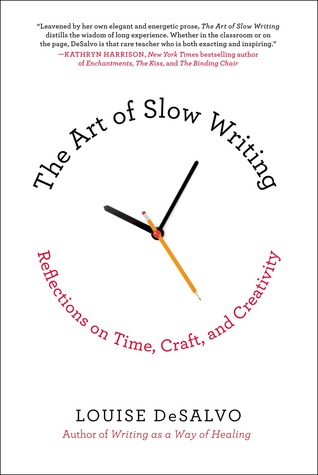
Favourite Writing Craft Book: The Art of Slow Writing by Louise DeSalvo


20613798Review by Paula Vince
 
In a series of conversational observations and meditations on the writing process, The Art of Slow Writing examines the benefits of writing slowly. DeSalvo advises her readers to explore their creative process on deeper levels by getting to know themselves and their stories more fully over a longer period of time. She writes in the same supportive manner that encourages her students, using the slow writing process to help them explore the complexities of craft. The Art of Slow Writing is the antidote to self-help books that preach the idea of fast-writing, finishing a novel a year, and quick revisions. DeSalvo makes a case that more mature writing often develops over a longer period of time and offers tips and techniques to train the creative process in this new experience.

DeSalvo describes the work habits of successful writers (among them, Nobel Prize laureates) so that readers can use the information provided to develop their identity as writers and transform their writing lives. It includes anecdotes from classic American and international writers such as John Steinbeck, Henry Miller, Virginia Woolf and D. H. Lawrence as well as contemporary authors such as Michael Chabon, Junot Diaz, Jeffrey Eugenides, Ian McEwan, and Salman Rushdie. DeSalvo skillfully and gently guides writers to not only start their work, but immerse themselves fully in the process and create texts they will treasure.


MY THOUGHTS:
 
When writing, it's easy to allow ourselves to be rushed by deadlines, impatience, or desire for feedback. The crux of Louise DeSalvo's book is to convince us that often, there is no shame in slowing down. Subjects of significance should be threshed out rather than rushed. Necessary reflection takes time, as well as putting it all into words. If our writing projects are important to us, wouldn't we rather end up with the greatest depth possible than a more shallow work full of surface issues and knee-jerk reactions to our topics?

The body of the book helps us to keep slowness in mind from the conception of our books through to the end product. I found that because of its subject matter, I felt free to ponder it for a long time without the guilt of procrastination for not getting on with something else.

Some of my favourite chapters include the necessity of daydreaming, keeping notebooks, and finding our own rhythms. DeSalvo is also a keen foodie who loves to spend time in the kitchen. She considers that being able to start and finish the preparation of a delicious meal within an hour or two is a welcome break from writing, which is more open-ended and often feels like forever. In another chapter, she encourages writers to set up a 'Mise en Place' like a chef's. Just as they have an area where ingredients are already waiting, prepped, measured and organised, we should keep research notes, documentation and resources close at hand.

This is a quite a thick, chunky book, and the chapters are meditative and easy to read, making it well worth reading over and over.


Paula Vince is a South Australian author of contemporary, inspirational fiction. She lives in the beautiful Adelaide Hills, with its four distinct seasons, and loves to use her environment as settings for her stories. Her novel, 'Picking up the Pieces' won the religious fiction section of the International Book Awards in 2011, and 'Best Forgotten' was winner of the CALEB prize the same year. She is also one of the four authors of 'The Greenfield Legacy', Australia's first and only collaborated Christian novel. Her most recent novel, 'Imogen's Chance' was published April 2014. For more of Paula's reflections, please visit her blog, The Vince Review where she also interviews other authors.


Monday, 20 April 2015

Favourite Writing Craft Book: Still Writing by Dani Shapiro


17465707

Review by Paula Vince

The back cover blurb of this book suggests that it should be placed on our shelves beside Anne Lamott's 'Bird by Bird' and Virginia Woolf's 'A Writer's Diary.' This recommendation, along with Amazon's 'Look Inside' feature had my interest piqued. It turns out to be a wonderful series of honest and thoughtful essays under the headings of Beginnings, Middles and Ends.

The book shows how life and writing are two inseparable strands in one rope. Dani Shapiro's life experiences, and the emotions they evoked, helped shape her books, and it is the same for us. She grew up as the lonely, only child of nervous, finicky parents who had her late in life. She lived with the pressure of being her creative mother's muse from a young age. Later, Shapiro's own baby boy was born with severe medical needs. Even though he grew to be a healthy young man, the mark these experiences left was branded on her soul.

The section on Beginnings has to do with adjusting our mindsets not only at the start of fresh projects but fresh days. Dealing with our inner censure (she calls hers a toxic little troll), our jigsaw puzzle minds, setting up conducive work environments and facing blank pages are some of the topics dealt with here. She also discusses good reading habits, picturing our audiences and giving ourselves permission to write.

Next comes Middles. This section helps us through those times when we've launched out okay but can't see any land in sight. Keeping in touch with our inspiration, clinging to trust, enjoying the rhythm, and perhaps having to backtrack and begin some parts again are some of the features. She helps us to examine our optimistic expectations that our writing projects should get easier at this point. I particularly appreciated Shapiro's comparing the middle of a story to humans who are considered middle-aged in true life.

Finally, her thoughts about Ends holds a congratulatory note that we've got so far. She discusses the promotional and business side of writing, as well as deadlines imposed by either ourselves or the world around us. Impatience is examined, and Shapiro warns us not to make the fatal mistake of pushing too quickly for shore as soon as we see the faint glimmer of a hazy horizon. Some authors may like her cautions about considering how family and friends may react to what we choose to disclose in our writing.

If you do get this book, I'd recommend that you keep a notebook and pen handy, as it's full of ideas which can't help making us say, 'I have something I can add to that.' I love the way Shapiro finishes with the title of her book. 'I am changing what I can. I am reaching a hand out to the dead and the living and the not yet born. So yes, I am still writing.'


Paula Vince is a South Australian author of contemporary, inspirational fiction. She lives in the beautiful Adelaide Hills, with its four distinct seasons, and loves to use her environment as settings for her stories. Her novel, 'Picking up the Pieces' won the religious fiction section of the International Book Awards in 2011,nd 'Best Forgotten' was winner of the CALEB prize the same year. She is also one of the four authors of 'The Greenfield Legacy', Australia's first and only collaborated Christian novel. Her most recent novel, 'Imogen's Chance' was published April 2014. For more of Paula's reflections, please visit her blog, The Vince Review.


Monday, 23 March 2015

Favourite Writing Craft Books - Story Engineering by Larry Brooks

Review by Ian Acheson

Photo courtesy of Storyfix.com
I was one of those novice writers that wrote my first manuscript using the organic drafting method (yes, I’m a pantser) rather than a well-defined plan that Larry Brooks encourages in this excellent guide to writing fiction.

In fact I wrote pretty much all of the first draft, all 250,000 words, without studying writing craft books in any detail. So theories of three-act structures with plot and pinch points were all part of a strange new lexicon that I understood conceptually but hadn’t practiced.

I then found myself an editor who taught me the basics of the craft of writing. And in so doing became enamoured by the writer/editor partnership.

I don't regret starting out this way primarily because it both taught me a lot but also confirmed to me that I had a "story" that could be written. Yes, I did work through 3 significant re-writes, a number of minor edits, and I estimate I wrote the best part of 1,000 pages for what ended up being a 380 page novel.

Enough of me, what about Story Engineering?

It’s sub-titled “Mastering the 6 Core Competencies of Successful Writing” which are as follows:

  • Concept
  • Character
  • Theme
  • Story Structure
  • Scene Execution
  • Writing Voice


I first read “Story Engineering” a number of years ago when I was in the process of a final major re-write of Angelguard. I found it an excellent reference point to check, not only the key structural elements of the story, but also the other concepts Brooks outlines.

I took pages and pages of notes that I still refer to today. In addition, Brooks provided access to a single page cheat sheet that summarises the key elements. I’ve particularly found his detailed outline of the 4-part story model and major story milestones invaluable as I work through other manuscripts. The pantser in me struggles to assimilate such a model when I set out on a new manuscript. It’s like my characters reject it telling me to trust them but I appreciate this model underpins the majority of novels and screenplays (3-act equivalent).

The book is very practical with many references to both his novels (he’s published at least six) and others. Yes, it could perhaps have been shorter (he likes his sports metaphors) but the key information is very accessible.

If you're new to fiction writing, or experienced but challenged to re-invent your process, or simply want an excellent reference guide, I’d encourage you to add "Story Engineering" to your writing craft collection.

Larry Brooks is an author of six psychological thrillers, is a freelance writer and writing instructor. He can found at Storyfix.com. which is often listed as one of the top blogs for writers.


Ian Acheson is an author and strategy consultant based in Northern Sydney. Ian's first novel of speculative fiction, Angelguard, is now available in the US, UK, Canada and Australia. He wonders if he'll ever finish the sequel, Wrestling with Shadows, but trusts Jack Haines is getting equally frustrated being away from the three girls that make his heart sing. You can find more about Angelguard at Ian's website, on his author Facebook page and Twitter

Monday, 1 December 2014

Favourite Craft Writing Books - Iola Goulton

Self-Editing for Fiction Writers by Renni Browne & Dave King


I give five-star ratings to books I know I’m going to read and re-read, and Self-Editing for Fiction Writers certainly falls in that category. It’s a book that was recommended to me by several authors, and I’ve recommended to others (who, in turn, have recommended it to others …).

If you are a fiction writer, this is one of the books you should have on your bookshelf. It’s not the first writing book you should buy (I’d recommend an up-to-date dictionary as the first book), and it won’t be much use until you’ve got a complete first draft that has been revised for plot, structure and characterisation. When you think you’ve done everything you can to improve the story, then it’s time to focus on line editing, which means it’s time to buy and apply Self-Editing for Fiction Writers.

The three main problems I see in fiction (especially self-published fiction, or fiction from certain small presses) are bad dialogue (and inappropriate dialogue tags), the tendency to tell not show, and the use of omniscient point of view. Self-Editing goes into all these issues in detail, explaining why you should (for instance) show not tell, how to spot the issues, and how to fix them.

It also covers subjects such as characterisation and exposition, interior monologue and personal voice or style. Some reviewers criticise Self-Editing for prescribing rules that make all fiction sound the same; I applaud it for showing why I find some fiction hard to read. The process of editing won’t take away your unique author voice, but it will help you refine and smooth that voice so your reader can understand and enjoy it. And isn’t that the point of writing fiction?


By Iola Goulton. I am a freelance editor specialising in Christian fiction, and you can find out more about my services at my website (www.christianediting.co.nz), or follow me on Facebook (https://www.facebook.com/christianediting), Twitter (@IolaGoulton) or Pinterest (http://pinterest.com/iolasreads).

I love reading, and read and review around 150 Christian books each year on my blog (www.christianreads.blogspot.com). I'm a Top 25 Reviewer at Christian Book, in the Top 1% of reviewers at Goodreads, and have an Amazon US Reviewer Rank that floats around 2500.


Monday, 24 November 2014

Favourite Writing Craft Book - Jeanette O'Hagan

On Writing 10th Anniversary Edition: A Memoir of the Craft
 by Stephen King (2010; first published 2000)


Stephen King is a veteran author who has wooed millions of avid fans with his own special brand of suspense, horror, faith and the battle between good and evil.  To date he has written 65 books and sold over 330 million copies.  To be honest, I’ve read only one of his novels – The Stand – and have watched the film adaptation of the emotional The Green Mile. 

Whatever you may think about his preferred genre, his book on the writing craft On Writing is an influential classic often quoted and still relevant some 14 years after it was first published.

As indicated in the title On Writing is part memoir, part handbook. King writes with a lucid, entertaining and humerous style peppered with the occasional strong language. The first one third of the book recounts the difficulties of his early childhood, his adventures as an adolescent, his burgeoning interest and success in writing, his enduring romance with his wife Tabitha, and his winning struggle against drug and alcohol addiction as a successful writer. Interspersed within this colourful narrative, with its focus on the influences that propelled King into his writing career, are occasional gems of writing advice. The last quarter of the book details King’s near encounter with death after being struck by a van in 1999 while halfway through On Writing . I found his honest account of this struggle to return to writing particularly moving.

The middle of the book (over a third), gives King’s approach to writing – from the prime rule ‘write a lot and read a lot’, the basic tools in the writers toolbox – vocabulary, grammar, style, and voice. He speaks about the writing process, how to court the muse (work consistently and hard), right through to finding ideas, critique, editing, looking for agents and publishers.   He has a lot of good stuff to say about adverbs, dialogue, description, characterisation, back story, research and theme. He is wary of writing groups (but not against them) and is even more sceptical of plotting – being the archetypical panster. And in all this, for him the story is king.

As a writer, I found On Writing refreshing and encouraging.  Even the middle section takes a much broader approach than the strictly how-to tomes that tend to focus on the mechanics. King’s book doesn't neglect the mechanics but I think he also addresses the heart. I was fascinated by King’s own writing journey and how his background (from a poor single parent family with strong work ethic and Methodist ties) has impacted on him as a man and a writer. I was particularly inspired by his discussions about how these principles worked in creating his own fiction. He is definitely in the ‘tell it how you hear it’ side of language debate – and is not averse to being blunt. On the other hand, themes of God, faith and redemption often recur in his fiction and he notes that these themes are important to him personally (see here also).


I’m glad I took to the time to read Stephen King’s On Writing. 

 Jeanette O’Hagan

“The rest of it - and perhaps the best of it - is a permission slip: you can, you should, and if you're brave enough to start, you will.”  
Stephen King, On Writing: A Memoir of the Craft


Jeanette has practiced medicine, studied communication, history and theology and has taught theology.  She is currently caring for her children, enjoying post-graduate studies in writing at Swinburne University and writing her Akrad's fantasy fiction series.  You can read some of her short fiction here. She is about to have a short story published as part of the Tied in Pink anthology next month (profits from the anthology go towards Breast Cancer research) . 

She is actively involved in a caring Christian community. 


You can find her at her Facebook Page or webistes  JennysThread.com or Jeanette O'Hagan Writes .

Monday, 10 November 2014

Structuring Your Novel, by KM Weiland


By Catherine Hudson

They say there are two basic types of writers: Pantzers and Plotters. 

I am, unashamedly, a Pantzer—one who would love to have the wonderful structure that seems to be available to Plotters. Structuring your Novel by K.M Weiland, has helped me begin to find that structure, without losing my natural fly-by-the-seat-of-my-pants style. To put it in plain English, as far as writing craft books go, this is one I love.

Perhaps it was an advantage that I had a finished manuscript to mentally compare to as I read this gem, but I think anyone would benefit from the advice laid out by Ms Weiland, in particular, new writers wanting to get a handle on the basics of structure.
After clearly telling us why we need structure (something I will not attempt to debate here, that’s a whole other blog post), she lays out structure from the hook to the resolution, before adding further chapters on scene and sequel.

The simple layout, using examples from literature and film, demonstrates exactly what is being taught. I have to admit, this is the book that made me finally understand the concept of a hook. I found myself Googling famous hooks and scribbling down various attempts for my own book. (No, I have not settled on one yet, but I’ll let you know when I do!)

Another useful element is the use of approximate percentages where a writer should place such things as inciting incidents, and character reflection, within their work. This was useful as I could go to my highly-edited, nipped and tucked WIP, and see if my inciting incidences now occurred at the right points to register subconsciously for the reader. Readers expect these moments and even though they may not be able to express this in writing terms, it will register when the structural pillars are missing from a novel.

Structuring your novel clearly teaches how to implement what is needed to produce a well-structured novel that holds up your story, rather than bringing it down.
Highly recommended.

Monday, 3 November 2014

Favourite Craft Books - Anne Hamilton

The Seven Basic Plots by Christopher Booker


My favourite craft book (apart from Madeleine L’Engle’s Walking on Water) is a superb book by Christopher Booker: The Seven Basic Plots - Why We Tell Stories (Continuum Books, 2004). It’s a story about story, I guess, and comes across as a narrative in its own right, rather than an analysis of technique.

The structure is one of the most difficult aspects of a novel to get anywhere near ‘right’. Although there are general rules to help (such as the climax should occur about 85% of the way through), there are in fact so many variables to consider that formula should always bow before the reader’s intuitive sense of correct narrative flow.

And what’s that exactly? How do writers tell what ‘works’?

As Booker points out, satisfying structures are in fact remarkably unoriginal. He’s found identical structures in a twentieth century novel and a medieval Asiatic folktale. Perhaps the reason they are both memorable may well be to do with the way readers resonate with the rhythm and flow of the storytelling.

What doesn’t work doesn’t survive.

So, if we want our work to survive, it’s good to look at the structure of various works of classic literature and copy it.

Right.

So what are the seven basic plots?

According to Booker, they are:

1. Overcoming the Monster
2. Rags to Riches
3. The Quest
4. Voyage and Return
5. Comedy
6. Tragedy
7. Rebirth

Notice that romance, thriller, historical fiction and so on don’t make the list. That’s because they’re genre, not plot. The confusion in many writers’ minds—where sometimes genre equals plot—is a problem. When plots meander in many modern novels and fail to deepen into any of the above (or any combination thereof), it means emotional impact is lost.

There’s a good reason archetypes should be used in structure: because they satisfy the human longing for story.

Booker discusses everything from literary classics to popular film as he throws up examples of why great storytelling endures. His book gave me real insight as to why some books ‘work’ and stick in the imagination—as well as why others fail and fade.

He takes the reader through the principles by which, for instance, Gone with the Wind follows the same ‘Voyage and Return’ motif as The Lion, the Witch and the Wardrobe! The book opens up a new way of thinking about how to shape a satisfying plot.

And the last reason it’s one of my favourite craft books is simply because its focus is so entirely on story narrative, not on formula.

Anne Hamilton is the author of eleven books. Her children’s books include Merlin’s Wood, Many Coloured Realm and Terry—The Adventures of a Terek Sandpiper.

You can find out more about Anne at her website: http://fire-of-roses.com/wp/


Monday, 27 October 2014

Favourite Writing Craft Books - Paula Vince

498501

Julia Cameron's most celebrated book is 'The Artist's Way' but I find 'The Sound of Paper' even more appealing. It's set up as a book of essays designed to stimulate anybody's creativity. At the end of each, she adds fun and practical 'Try This' exercises, sometimes as simple as writing lists but still effective. I love it that the book focuses a lot of attention on the attitudes writers and other artists should try to embrace. Our mindsets are the foundation of our craft, and so many other books delve straight into more technical aspects such as plot or characterisation. This is a great book for anybody who battles with lack of confidence or writer's block.

Cameron uses everyday examples from the world around her as analogies to make her points about creativity. As she lives in New York City for half the year, and remote Taos, New Mexico for the other half, this covers a lot of ground. It's very entertaining to read the vivid, beautiful descriptions, and being inspired to get writing makes them really special.

I appreciate the many anecdotes about experiences of her writer or artist friends and clients. As well as encouraging me that I'm not the only person who needs the lessons, it gives a sense of solidarity. It's very easy, after reading this, to feel that our 'tribe' is far larger than we ever imagined. This alone is such an encouragement to keep going.


Paula Vince is a South Australian author of contemporary, inspirational fiction. She lives in the beautiful Adelaide Hills, with its four distinct seasons, and loves to use her environment as settings for her stories. Her novel, 'Picking up the Pieces' won the religious fiction section of the International Book Awards in 2011, and 'Best Forgotten' was winner of the CALEB prize the same year. She is also one of the four authors of 'The Greenfield Legacy', Australia's first and only collaborated Christian novel. Her most recent novel, 'Imogen's Chance' was published April 2014. For more of Paula's reflections, please visit her blog, It Just Occurred to Me. You may also like to visit her book review blog, The Vince Review where she also interviews other authors.


Monday, 20 October 2014

Favourite Writing Craft Book - Jo-Anne Berthelsen


Bird by Bird: Some instructions on writing and life by Anne Lamott
Originally published by Anchor Books (Random  House) 1994
Aust/NZ edition Scribe Publications 2008

What inspired you to read this book?
Jo-Anne: I came across Anne Lamott’s Bird by Bird by accident, while browsing in a large bookstore around six years ago, and was immediately intrigued by its title. Why call a book about writing Bird by Bird? After reading the explanation on the back cover, I became even more intrigued. Anne Lamott sounded so original and quirky—I had never heard of her and wanted to find out more. And when I did, I was not disappointed. In this memoir-cum-writing instruction book, Anne Lamott manages to combine honest glimpses into her own slightly crazy life with wonderful lessons on key aspects of writing in a way that is witty, insightful, sad, colourful, disarming and self-deprecating—but, above all, never boring.

How has this writing craft book helped you to improve your writing?
Jo-Anne:  It’s hard to be brief here, but I’ll focus on two main ways.

Firstly, I felt validated as an author by so much of what Anne Lamott wrote about her approach to writing—and this gave me more confidence that I was on the right track myself. I had written two or three novels by the time I discovered Bird by Bird but still had so many questions about myself as an author. For example, I wondered if it was ‘okay’ to go with what my characters seemed to want to do and say. Then I read the following in Anne Lamott’s chapter on ‘Plot’ and loved it:

Over and over I feel as if my characters know who they are, and what happens to them, and where they have been and where they will go, and what they are capable of doing, but they need me to write it down for them because their handwriting is so bad. (p 60)

Secondly, her encouragement to be honest in what I produced helped me to write with more integrity. For example, her chapter entitled ‘Character’ challenged me to treat my own characters with more respect:

You make up your character, partly from experience, partly out of the thin air of the subconscious, and you need to feel committed to the exact truth about them, even though you are making them up.  ... Just don’t pretend you know more about your characters than they do, because you don’t. Stay open to them. It’s teatime and all the dolls are at the table. Listen. It’s that simple. (p 52)

Why would you recommend this book to other writers?
Jo-Anne:  Bird by Bird includes great information not only on the ‘how to’ of writing a novel or memoir but also on how to be a writer. There are many excellent chapters in Part One, entitled  ‘Writing’, on matters such as first drafts, plot, character, setting and dialogue. But Part Two, ‘The Writing Mind’, contains even more gold, in my opinion, on topics such as the moral point of view, overcoming self-doubt, and dealing with jealousy—things that can cripple us as authors. Parts Three and Four also offer many wise suggestions in areas such as obtaining help from others, finding your voice and handling publication.  

Who do you believe would benefit the most from reading and studying this book?
Jo-Anne:  The back cover states that Bird by Bird is for both ‘serious writers and writers-to-be’—and I agree, although I do think those a little further into their writing journey might benefit most.


Jo-Anne Berthelsen lives in Sydney but grew up in Brisbane. She holds degrees in Arts and Theology and has worked as a high school teacher, editor and secretary, as well as in local church ministry. Jo-Anne is passionate about touching hearts and lives through both the written and spoken word. She is the author of six published novels and one non-fiction work, Soul Friend: the story of a shared spiritual journey. Jo-Anne is married to a retired minister and has three grown-up children and four grandchildren. For more information, please visit www.jo-anneberthelsen.com.

Monday, 13 October 2014

Favourite Writing Craft Books - Ian Acheson


Photo courtesy of
JamesScottBell.com
I've found this book to be invaluable in working through my current manuscript. Bell outlines the significance of identifying the magical midpoint moment or "Mirror Moment" when structuring one's story.

The “Mirror Moment” Bell outlines is exactly that, a moment in a scene, not an entire scene, reflecting the midpoint of your novel. It’s that moment when the protagonist “takes stock of where he/she is in the conflict” and assesses what to do in order to be successful.

On determining this "moment", the author is able to move backwards in building to the midpoint and then forwards in forming the transformation that needs to take place.

I found in my current WIP I was stuck with too many conflicts which was leading me down too many dead ends. Being able to crystalise this moment has allowed me to remove the nebulous conflicts and drive harder towards a resolution.

In providing practical examples from both famous novels and movies Bell effectively demonstrates the power this gives the author in both setting up the story and taking it through to its end. Two of the movies he refers to: Lethal Weapon and The Fugitive are ones I know very well and so I had one of those “aha” moments when he relayed their “look in the mirror moment.”

Bell outlines how this works for the plotter, the pantser (that’s me) and everyone in between. He also references how it impacts the character-driven and plot-driven approaches to a novel.

In addition, this short book (only 85 pages) provides a quick overview of story structure, the impact of genre and some extra bonuses at the end. I expect much of this last section to be familiar to many of the resident Bell supporters amongst our ACW clan but it’s in a useful summary form, easy to digest.


Ian Acheson is an author and strategy consultant based in Northern Sydney. Ian's first novel of speculative fiction, Angelguard, is now available in the US, UK, Canada and Australia. You can find more about Angelguard at Ian's website, on his author Facebook page and Twitter

Monday, 29 September 2014

Favourite Writing Craft Books - Andrea Grigg

What a gem of a book! And a big thank you to either Ellie Whyte or Catherine Hudson for putting me on to it – I know one of you did.

The Word-Loss Diet isn’t a large tome by any means (thirteen chapters over seventy-one pages) but its ideas have had a huge impact on my writing. My first drafts are always too big, but now I have the tools to reduce my word count in a pain-free manner without sacrificing the plot.

Let me give you a tiny taste.  

How many times do we use the words, started to, turned to, and could? Rayne Hall shows why they’re redundant in a concise and practical manner. The method she uses to explain is in keeping with the dietary theme – the examples are labelled ‘obese’ and ‘slim’ :)

We all want to make our writing tight and toned as well as enhance our self-editing skills don’t we? This book will show you how. And while it’s not recommended for absolute beginners, I think it makes a great mentorship tool.


I purchased my copy via Amazon. The Kindle edition is less than $4.00, the paperback version around $7.00. Whichever one you choose, The Word-Loss Diet is worth every cent.


Andrea writes contemporary romance. Her second novel Too Pretty was released in August 2014 by Rhiza Press. Her first book A Simple Mistake was a finalist in the CALEB Awards 2012

Andrea would love to hear from you via her website or Facebook page:
http://www.andreagrigg.com/
https://www.facebook.com/author.andreagrigg

Monday, 22 September 2014

Favourite Writing Craft Books - Rita Stella Galieh

(Taken from Amazon's site)
The very name of this book drew me in. I wanted write great fiction and that's what was promised if I followed James Scott Bell's guidelines. That is, how to follow techniques for crafting a plot that grips readers from start to finish..

I was really inspired to purchase this book when I realized  I couldn't simply meander and write every single thing I thought relevant. What I needed was STRUCTURE and clear plot lines.


Plot and Structure opened me up to techniques I have found invaluable to my whole writing experience. Now I had a guide, almost a mentor, if you like, pointing out the way ahead, and how to avoid mistakes on the way!


I heartily recommend Plot and Structure for writers, especially if you have a story in mind but are struggling not only with a gripping beginning, but a sagging middle. MIDDLES have always been the most challenging parts to a writer. And definitely if you are a 'Pantser'. It will help in organizing yourself to have a plan and know where you're going. I actually picked out the relevant points I needed to follow and printed them on four large cards which I pinned up in my line of sight. It saved me from reading the manual every time I needed help.


*  Singer/songwriter, Rita Stella Galieh is a scriptwriter and co-presenter on Vantage Point, a 5 minute program broadcast throughout Australia. Having graduated from Emmaus Bible College and Sydney's National Art School, she is now with the Living Word Literary Agency, waiting for a publisher to accept her latest novel. As a contributor to several US Anthologies by Adams Media, she has two Historical Romances published by Ark House Press. Each year she and her husband minister in Buddhist Government schools, prisons, hospitals, shopping malls, and churches in Thailand. Her weekly blog, http://inspirational romance.blogspot.com shares fascinating stories.

You can follow her on Twitter: @RitaSGalieh

Monday, 7 July 2014

First Chapter Blues

By Anne Hamilton

The human brain is ‘wired for story’, according to Lisa Cron, when discussing brain science to craft stories. Probably even before Scheherazade invented the cliff-hanger so her husband wouldn’t kill her, humans have felt a sense of satisfaction with some story-telling styles and not with others.

Sure there can be cultural differences. In the west, we like an underpinning of logic. In Japan, mood and atmosphere are the all important features. Master story-tellers know how to spin out a tale so the audience, like Goldilocks, feels it sits just right. Such knowledge comes from lots of practice and discovering when and where the audience responds.

In the last few centuries, genre fiction has acquired the air of being very formulaic. To a degree this is true. As an editor, I often encounter authors wanting to break the mould. However, there’s a very good reason for the formula: it is the one publishers have found from long experience most satisfies the human craving for story. If you’re going to break the formula, you need to think hard and long about why.

First chapters have to be an author’s best writing for many reasons: not least because often it’s all a commissioning editor will look at. (And often they won’t even look at all of it.) So what makes a good first chapter? Most writers today realise that opening with a narrative hook is almost essential. Tick that as pretty much common knowledge.

However, beyond that, it can be uncharted territory. Let’s look at mistakes to avoid. Most common problems fall into two categories: structure and character development.
  • The narrative hook should be integral to your story, not a tacked-on introduction of high-level drama or mystery. The story shouldn’t fall after the opening and flatten out, it should dip before rising again to a mini-crisis at the end of the first chapter.
  • If, just past the narrative hook, the story pauses to spill an information dump on the reader or fill in several paragraphs of backstory, all the momentum of the opening is lost.
  • If the story backtracks after the opening to reveal what led up to the narrative hook, then the forward movement is stalled and it’s usually immensely difficult to retrieve it.
  • If the beginning features nameless characters performing vague, mysterious actions, it’s not necessarily intriguing. The author may be aware of the significance of it all but, for the reader, there’s a risk of losing the plot before it’s even started.
  • Perhaps the biggest mistake, however—because it doesn’t seem like a mistake—is revealing the protagonist’s trauma too soon. This is an issue I increasingly encounter. Way back in the character’s past, there’s a critical incident that’s the key to their behaviour. Without this, nothing about their actions makes true sense. Unfortunately because authors wants readers to like their characters from the start, they can be premature in their revelations.
Instead of dropping little hints, building up a list of clues and letting the reader savour the mini-mystery, authors are increasingly tending to adopt this counter-productive strategy. Just as the emotional impact of hearing about a friend’s trauma is much greater than that of hearing about a stranger’s, so too it is with characters we’ve come to know through the course of a story. It’s better to leave it until a much later chapter where it can deepen our appreciation of a chara
cter and create a rounder, more full-bodied impression.

These five structural/developmental points are ones that tend to put me off, right from the start. Do you share this? Or find there are others annoy you more?

Anne Hamilton is an editor and author. She once taught mathematics for three decades. Her new book analyses the mathematics of one of the greatest of all English poems, Sir Gawain and the Green Knight.